Snow changes Banff completely, but you don’t need to be a skier or take on a challenging mountain trail to enjoy it. Some of our favourite easy winter hikes in Banff are short, manageable walks with beautiful mountain views, frozen waterfalls and snow-covered forests. As Canmore locals who spend a lot of time hiking in Banff National Park year-round, these are the trails we recommend to visitors who want to enjoy the beauty of Banff in the winter.
The best Banff winter hikes range from almost-flat walks around frozen lakes to short trails with just enough climbing to reward you with an incredible viewpoint. Many are also excellent Banff winter activities for non-skiers, whether you’re visiting for a winter vacation or simply looking for something to do between days on the ski hill.
Winter hiking season in Banff can start well before the official beginning of winter. Snow often arrives in the Canadian Rockies in the fall and can linger well into spring, which means many of these trails can be enjoyed for much of the year. Conditions can vary considerably, though, especially after a fresh snowfall.
One of the things we like most about these easy winter hikes in Banff is that the popular trails are often packed down enough that you won’t need snowshoes. We typically carry microspikes for extra traction on icy sections, while snowshoes can be useful after a significant snowfall. Always check current trail and weather conditions before heading out.
Below, we’ve shared our favourite easy winter hikes in Banff National Park, including short walks near the Banff townsite, frozen waterfalls, Lake Louise trails and an easy Icefields Parkway viewpoint. We’ll also point out which hikes have more climbing, which are best for families and where you can combine your hike with other winter activities.

This post contains compensated links.
Planning a winter trip to Banff?
The Banff & Jasper Planning Hub includes our Banff Winter Travel Guide, with practical winter advice, activity ideas, seasonal tips, and local guidance to help you plan your trip without feeling overwhelmed.
Best Easy Winter Hikes in Banff National Park
These are our favourite easy winter hikes in Banff National Park. Some are almost flat, while others include a steady climb, but they’re still on the easier side of things by Rocky Mountain hiking standards.
Winter hiking is also one of the best free things to do in Banff in winter, which makes these trails a great way to balance out some of Banff’s more expensive winter activities.
Just keep in mind that “easy” does not mean effortless in winter. Snow, ice and cold temperatures can make even a short trail feel more challenging, so be sure to wear proper footwear and traction devices, and check current conditions before heading out. We’ve included more winter hiking tips further down in the post.
Read More
Winter is one of the best times of year to visit Banff National Park, but it can be tricky knowing what to bring. Before you come, be sure to read our Banff packing list for winter.
Lake Louise Lakeshore Trail
Distance: up to 4.7 km out-and-back, Elevation Gain: minimal
The Lake Louise Lakeshore Trail is one of the easiest winter hikes in Banff National Park, with very little elevation gain and incredible mountain scenery from start to finish. It’s an excellent choice for families, anyone looking for a relaxed winter walk, or visitors who simply want more time to enjoy Lake Louise beyond the main viewpoint.

The trail follows the edge of Lake Louise toward the far end of the lake. While the views are impressive as soon as you arrive, walking the lakeshore gives you a completely different perspective of the surrounding mountains and the Fairmont Chateau Lake Louise behind you. At the far end, you may also see ice climbers on the frozen waterfall.
We recommend allowing plenty of time for your winter visit to Lake Louise. There is much more to do here than simply stop for the famous view, especially if you combine the Lakeshore Trail with skating at Lake Louise, sightseeing or another short winter hike.

If you’d rather leave the winter driving to someone else, this guided Lake Louise and Yoho winter tour from Banff is a convenient way to visit Lake Louise as part of a full-day outing. The tour includes transportation from Banff, time at Lake Louise and a lakeshore walk before continuing to Emerald Lake and other stops in Yoho National Park. It’s a great option if you don’t have a rental car or would simply prefer to enjoy the scenery without worrying about winter road conditions.
For more ideas on how to make the most of your day, read our complete guide to visiting Lake Louise in winter.
Johnston Canyon to the Lower Falls
Distance to Lower Falls: 2.4 km out-and-back, Elevation Gain: 118 m
One of the best overall hikes in Banff National Park and one of its most popular attractions, Johnston Canyon is another of our all-time favourite easy winter hikes in Banff. As locals, we actually tend to visit Johnston Canyon more often in winter than in summer.

For an easy winter outing, we recommend hiking to the Lower Falls. The trail follows Johnston Creek through the canyon, with sections of elevated catwalk built into the canyon walls. In winter, snow and ice completely change the scenery, and the short walk to the Lower Falls gives you a great payoff without requiring a long or difficult hike.
At the Lower Falls, you can get surprisingly close to the frozen waterfall before turning around. The trail can get very icy in winter, so we recommend wearing microspikes even though the hike itself is relatively easy.
If you have more time and want a longer hike, continue past the Lower Falls to the Upper Falls. This section involves more climbing, but you’ll be rewarded with another impressive frozen waterfall and may even see ice climbers on the massive wall of ice. It’s very exciting to watch!

For an even bigger day, you can continue beyond the Upper Falls on the winter hike to the Ink Pots. The trail becomes much quieter once you leave the main Johnston Canyon route, and recent snowfall can make this section more challenging. If there has been fresh snow, snowshoes may be useful.

Johnston Canyon is also home to one of Banff’s most popular guided winter experiences. The Johnston Canyon Icewalk tour from Banff is a great option if you don’t have your own winter hiking gear, aren’t comfortable tackling an icy trail on your own, or simply want to learn more about the canyon while you walk. Transportation from Banff, ice cleats and a professional guide are included, making this an especially convenient option for visitors without a rental car. You’ll still get to experience the frozen waterfalls and dramatic winter scenery, but with someone else taking care of the logistics.
For trail details, parking information, what to expect at the Lower and Upper Falls and more tips from our visits, read our complete Johnston Canyon hiking guide.
Read More
If you’re planning more than just hiking, see our complete guide to the best things to do in Banff in winter for our favourite winter activities, sightseeing experiences and ideas for building your Banff itinerary.

Need Help with Your Banff Itinerary?
Visiting Banff in winter? The Banff & Jasper Planning Hub includes our 7-Day Banff Winter Itinerary, with carefully planned days and fun winter activities based on our years of exploring Banff in winter.
Peyto Lake Viewpoint Trail
Distance: 1.1 km out-and-back, Elevation gain: 30 m
The Peyto Lake Viewpoint Trail is one of the shortest easy winter hikes in Banff National Park, but the payoff is huge.
In winter, the paved summer trail to the famous viewpoint over Peyto Lake is covered in snow, so this feels more like a short snowshoe or winter walk than a typical paved viewpoint trail. The climb is brief, and once you reach the viewing platform you’re rewarded with a sweeping view over frozen Peyto Lake and the surrounding peaks.

Peyto Lake is quite a distance from the Banff townsite, so we wouldn’t recommend driving all this way just for this short hike. Instead, make it one of the stops on a winter drive along the Icefields Parkway, one of the most scenic drives in the world. Peyto Lake is about 40 km north of the Lake Louise junction, and there are plenty of other viewpoints and short stops you can combine with it along Highway 93 North.
Winter driving on the Icefields Parkway requires more planning than it does in summer. Be sure to check current road and weather conditions before leaving, and give yourself plenty of time for the drive.
If you want to know where to park, what to expect on the walk and how to get the best views, read our complete guide to visiting Peyto Lake in Banff National Park.
And if Peyto Lake is part of a bigger sightseeing day, our Icefields Parkway scenic drive guide covers our favourite stops, drive times and practical tips for planning this spectacular route.
Sulphur Mountain Boardwalk
Distance: 1 km out-and-back, Elevation Gain: 368 stairs
The Sulphur Mountain Boardwalk is one of the easiest ways to enjoy incredible mountain views in Banff in winter. Instead of hiking all the way up Sulphur Mountain, take the Banff Gondola to the summit and follow the wooden boardwalk along the ridge to Sanson Peak.

The boardwalk is approximately 0.5 km each way, but don’t let the short distance fool you into thinking it’s completely flat. There are 368 shallow steps along the route as the boardwalk goes up and down the ridge. The overall elevation difference between the Banff Gondola Upper Terminal and Sanson Peak is only about 10 metres, making this a manageable winter walk for most visitors.
The payoff is excellent for such a short walk. You’ll have wide-open views over the Bow Valley and surrounding mountain ranges, and at Sanson Peak you can see the historic weather observatory and the remains of the Sulphur Mountain Cosmic Ray Station National Historic Site.
We especially like this option for visitors who want to experience a winter walk on a mountaintop without taking on a traditional winter hike. Just remember that you’re at over 2,200 metres above sea level, so it can feel much colder and windier at the summit than it does in the Banff townsite.

If you’re planning to ride the gondola, our complete guide to the Banff Gondola has everything you need to know about tickets, parking, how long to allow and what to do at the summit.
Johnson Lake Trail
Distance: 3.1 km loop, Elevation Gain: 70 m
Johnson Lake is one of the easiest winter hikes in Banff National Park and a great option when you want a short scenic walk near the town of Banff.
Starting at the Johnson Lake Day Use area, you can hike the full loop around the lake, which includes a forested section, or simply follow the trail along the lakeshore and turn back whenever you like. We especially like the sections closer to the water, where you get more open views across Johnson Lake and the surrounding mountains. The views of Cascade Mountain across the lake are amazing!

If conditions are right, you can also combine your winter hike with some time on the ice. Johnson Lake is one of the places where natural ice skating may be possible during winter, although conditions can vary quickly.
If Johnson Lake sounds like a good fit for your day, our complete Johnson Lake hiking guide has everything you need to plan your visit, including the trail route, parking information and what to expect along the way.
Read More: Where to Go Ice Skating in Banff


Banff App Pick: AllTrails
AllTrails is one of our most recommended apps for visiting Banff, and your trip is the perfect time to try AllTrails Plus. Start with the 7-day free trial to download maps, save hikes, and use premium features before heading into the mountains.
Two Jack Lake Trail
Distance: 3.2 km out-and-back, Elevation Gain: 184 m
If you’re already driving the Lake Minnewanka Scenic Drive to hike around Johnson Lake, the Two Jack Lake Trail is an easy add-on that gives you more time outside.
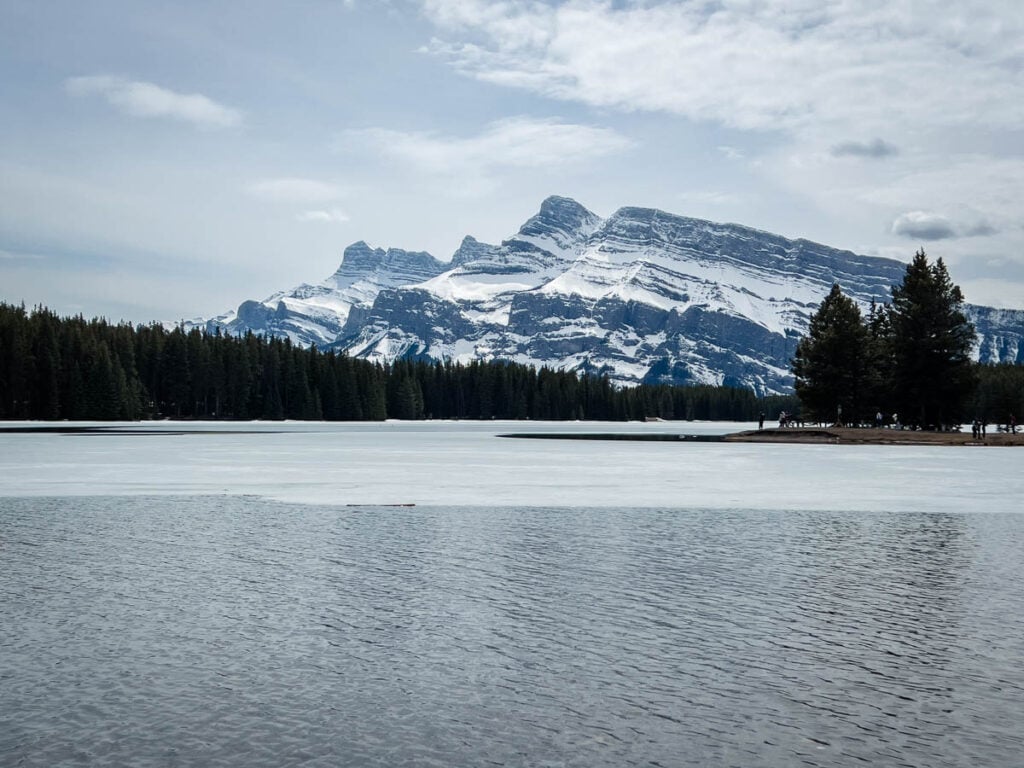
From the parking area, you can walk along the wooded lakeshore past Two Jack Lakeside Campground toward the outflow canal. It’s a relaxed winter walk with beautiful views across the lake and surrounding mountains, and you can simply turn around whenever you’ve had enough.
We especially like combining Johnson Lake and Two Jack Lake on the same outing. The two stops are close together, and together they make for a much more complete half-day of easy winter hiking and sightseeing around the Lake Minnewanka area.
Marsh Loop Trail
The Marsh Loop Trail is one of the easiest winter hikes in Banff National Park. This 2.8 km loop has minimal elevation gain, making it a great choice for families or anyone looking for a relaxed winter walk without much climbing.
The trail starts at the Cave and Basin National Historic Site and circles through the wetlands at the base of Sulphur Mountain before reaching the Bow River. We especially like the open sections along the river, where you get beautiful views across the Bow Valley and surrounding mountains. In winter, the warm-water wetlands also make this an interesting place to look for birds and animal tracks in the snow.

We recommend combining the Marsh Loop with a visit to the Cave and Basin National Historic Site. The boardwalks, thermal springs and exhibits make it easy to turn this short winter hike into a much more complete outing.
If you want a longer hike from the same starting point, you can continue along the Sundance Trail to Sundance Canyon. Surprisingly, despite hiking and biking this trail many times, we’ve never done Sundance Canyon in winter. We expect the combination of the Bow River, mountain views and snow-covered forest would be beautiful, with the frozen waterfall in Sundance Canyon providing a great payoff at the end. Keep in mind that this is a much longer outing than the Marsh Loop and the canyon section is more challenging, especially when icy.
For more ideas around this historic area of Banff, read our complete guide to visiting the Cave and Basin National Historic Site, including the boardwalks, Marsh Loop and other things to do nearby.
Fenland Trail Loop
Distance: 1.9 km loop, Elevation Gain: 49 m
The Fenland Loop Trail is one of the easiest winter hikes in Banff and a great option if you want to get outside without much elevation gain. The roughly 2 km loop winds through a quiet forest and wetland area just outside the centre of town.
Because the trail is right in the Banff townsite, it’s an easy Banff hike you can do without a car. That makes Fenland Loop especially useful for visitors staying in Banff who want an easy winter walk they can reach on foot.
It’s also a good choice on days when you want something short and relaxed rather than a bigger mountain hike. You still get that snowy Rocky Mountain atmosphere, but without a long drive or a strenuous climb.
If you’re planning a car-free visit, see our guide to the best hikes from the Banff townsite for more trails you can reach without driving.
For route details and current trail information, see the Fenland Trail loop on AllTrails.
Surprise Corner to Hoodoos Trail
Distance: 10 km out-and-back, Elevation Gain: 305 m

The Surprise Corner to Hoodoos Trail is one of the longer easy winter hikes in Banff, but the elevation gain is still quite manageable considering you are hiking in the mountains. It’s a great option if you are capable of a longer hike, but don’t want a ton of elevation.
Starting at Surprise Corner, you get one of the best views of the iconic Banff Springs Hotel. From there, the trail winds through the forest with frequent views of the Bow River and Mount Rundle.

As you climb toward Tunnel Mountain Road, the trail opens up to wide views over the Bow Valley. You can also drive directly to the Hoodoos Viewpoint, but hiking there makes the experience much more rewarding and gives you far more scenery along the way.
If you want a scenic winter hike close to the town of Banff without too much climbing, this is an excellent choice. Our complete Surprise Corner to Banff Hoodoos hiking guide includes the full route, parking information, trail details and what to expect along the way.

Tunnel Mountain Trail
Distance: 4.6 km out-and-back, Elevation Gain: 266 m
Tunnel Mountain (also known as Sleeping Buffalo) is one of the most popular hikes near the Banff townsite, and it’s a great choice for a winter summit without taking on a big mountain hike. The Tunnel Mountain hike is popular enough in winter that the trail is often well packed down.

The climb is gradual but steady, so some hikers may find the uphill more challenging than expected. That said, we regularly see hikers of all ages and abilities completing Tunnel Mountain, and the relatively short distance makes it manageable for many visitors who are comfortable with a bit of climbing.
You’ll be rewarded with excellent views over the Banff townsite, the Bow Valley and the surrounding mountains. It’s also one of our favourite family hikes in Banff. For kids who are ready for some uphill effort, reaching the summit can feel like a real accomplishment without requiring an all-day hike.
If you’re travelling with children, see our complete guide to the best kid-friendly hikes in Banff for more family hiking ideas.

Tunnel Mountain is also one of several hikes you can do right from town. Our guide to the best hikes from the Banff townsite has more options if you want to hike without driving to a trailhead.
For full trail stats, parking information, route details and what to expect on the climb, read our complete Tunnel Mountain hiking guide.
Wildlife Safety
When hiking in Banff National Park, you are responsible for your own safety. Before hitting the hiking trails, we highly recommend you read our Essential Banff Hiking Tips for information about bear safety, trail conditions, wildlife warnings and possible closures.
Upper Stoney Lookout Trail
Distance: 4.3 km loop, Elevation Gain: 239 m
The Upper Stoney Lookout winter hike is a good option when you want a little more of a challenge. The climb through the forest is steady and can feel steep in places, but by Banff National Park standards, we still consider this one to be on the easier end of your winter hiking options.
Most of the Upper Stoney Lookout hike is through the trees, which makes it especially pretty after fresh snow. Once you reach the lookout, you’re rewarded with views of Cascade Mountain and the Bow Valley before the trail loops back downhill toward the parking area.

We often do this winter hike while our kids are taking ski lessons at Mount Norquay. It’s a convenient way to get outside for a couple of hours while they’re on the slopes, and we’ve done it in a mix of winter conditions over the years.
The trail is popular with winter hikers, snowshoers and fat bikers. Depending on recent snowfall, you may find it packed down enough for microspikes, while after fresh snow, snowshoes can be the better choice. If you’re unsure what traction to bring, our guide to winter traction devices for hiking explains when we use microspikes, crampons and other options.
If you’d like more snowshoe ideas, we also have a guide to the best snowshoe trails in Banff.
For full trail details, parking information and what to expect on the route, read our complete guide to the Upper Stoney Lookout winter hike.
Fairview Lookout Trail
Distance: 2 km out-and-back, Elevation Gain: 165 m
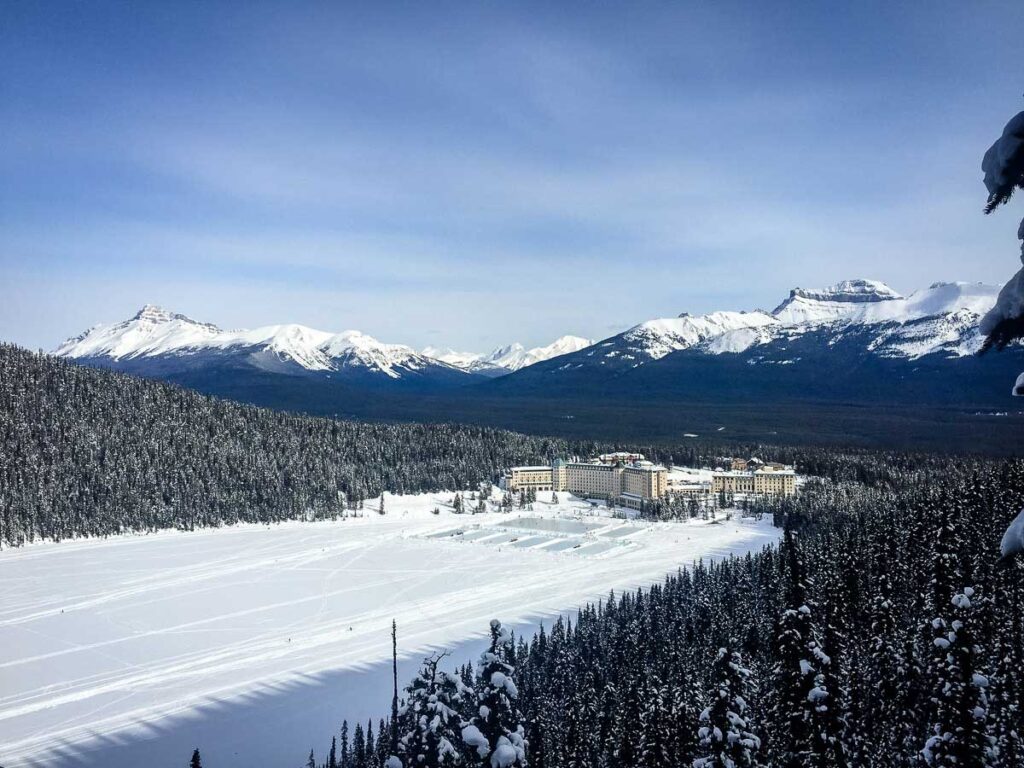
If you’re looking for a short winter hike at Lake Louise with a little more climbing, the Fairview Lookout Trail is well worth the effort. The trail climbs through the forest to a viewpoint overlooking frozen Lake Louise and the Fairmont Chateau Lake Louise.

Despite being relatively short, the uphill section is steady enough that you’ll notice the climb. The payoff comes quickly, though, and the elevated view across the lake is very different from what you get along the lakeshore.
From the main Lake Louise viewpoint, with the lake in front of you, the Fairview Lookout Trail starts to the left. In winter, we recommend treating this as an out-and-back hike and returning the same way once you’ve enjoyed the viewpoint.
If you want to add a short hike with a great payoff to your day at Lake Louise, our complete Fairview Lookout winter hiking guide has the trail details, parking information and tips you’ll need before you go.
Essential Tips for Winter Hiking
Winter hiking requires more preparation than summer hiking. Know the terrain, check conditions and be prepared for changing weather.
Always check the weather forecast and be prepared to turn back if the weather changes. The weather can change quickly in the mountains and blowing snow can reduce visibility to near zero.
Be aware of the terrain you are hiking into and only venture into avalanche terrain if you know what you are doing. Learn the avalanche basics from Avalanche Canada.
What to Wear for Winter Hiking in Banff
As you can imagine, dressing properly for winter hiking in Banff is imperative for your comfort and safety. If you plan to spend a lot of time outdoors in Banff this winter, these resources will help you prepare:
We discuss all your winter clothing options in our post on Banff winter essentials.
As you’ve seen above, you’ll likely need some traction devices (like microspikes or snowshoes) to enjoy many of these easy winter hikes in Banff. There are different kinds for different purposes, so before you go, be sure to read our post on traction devices for winter hiking in Banff.
Winter Hiking with Kids

Keeping kids warm and dry is the key to successfully hiking in the winter with kids. For more advice, see our complete guide to winter hiking with kids on Family Can Travel.

Winter is an exceptional time to explore Banff and the surrounding area. With the right hiking gear for winter and preparation, hiking is an easy way to enjoy the mountains beyond skiing and snowshoeing. When you are looking for things to do in winter in Banff other than snowshoeing or skiing, add winter hiking in Banff to your itinerary.
Support Human Created Content

Hi, we’re Dan & Celine Brewer, locals from just outside Banff National Park. Every article, itinerary, and recommendation we share is rooted in our real experiences and love for this place. If you’ve found our content helpful, please consider supporting us:
- Make a small donation: Your support directly fuels our work and keeps our stories genuine.
- Purchase a guide or itinerary: Essential tools that help plan your trip and support local creators at the same time.
- Book lodging or tours through our affiliate links: You pay the same price, but we earn a small commission that helps us keep producing content.
Thank you for valuing authentic, human-created content. Your support allows us to help even more Banff travellers!

Dan Brewer, a life-long Alberta resident, calls Canmore home along with his wife and two kids. He is the co-owner of Travel Banff Canada, where he gets to share his passion for the Canadian Rocky Mountains. Dan, along with his family, love being outdoors doing one of the many activities they enjoy in the mountains: hiking, mountain biking, paddleboarding, skiing, snowshoeing and cross-country skiing.
When he's not in Canmore enjoying one of his favourite local hikes, you can find him hopping on a plane to explore a new country with his family or working on one of their other two travel sites: Family Can Travel and Baby Can Travel.