Cycling through Banff National Park offers some of the most spectacular mountain scenery in the world. With so many biking opportunities ranging from paved recreational paths to challenging road routes, Banff has something for every cyclist looking to explore the Canadian Rockies on two wheels.
As locals living just outside Banff National Park, we love nothing more than getting on our bikes and enjoying a ride through the stunning mountain scenery that we call home.
Whether you’re seeking a leisurely ride with stunning mountain views or a challenging climb along a scenic road, this comprehensive guide covers the best Banff bike trails for all skill levels.
This post contains compensated links.
Best Paved Bike Trails in Banff
Here are the best Banff bike trails, including paved pathways, roads closed to vehicles and road cycling routes. Don’t forget to add one great bike ride in Banff to your itinerary!
Prefer to listen? Here’s the podcast episode I did on the Best Banff Bike Trails:
1. Rocky Mountain Legacy Trail (Banff Legacy Trail)
Distance: 26.8 km one-way (Canmore to Bow Valley Parkway)
Difficulty: Easy to Moderate
Surface: Paved
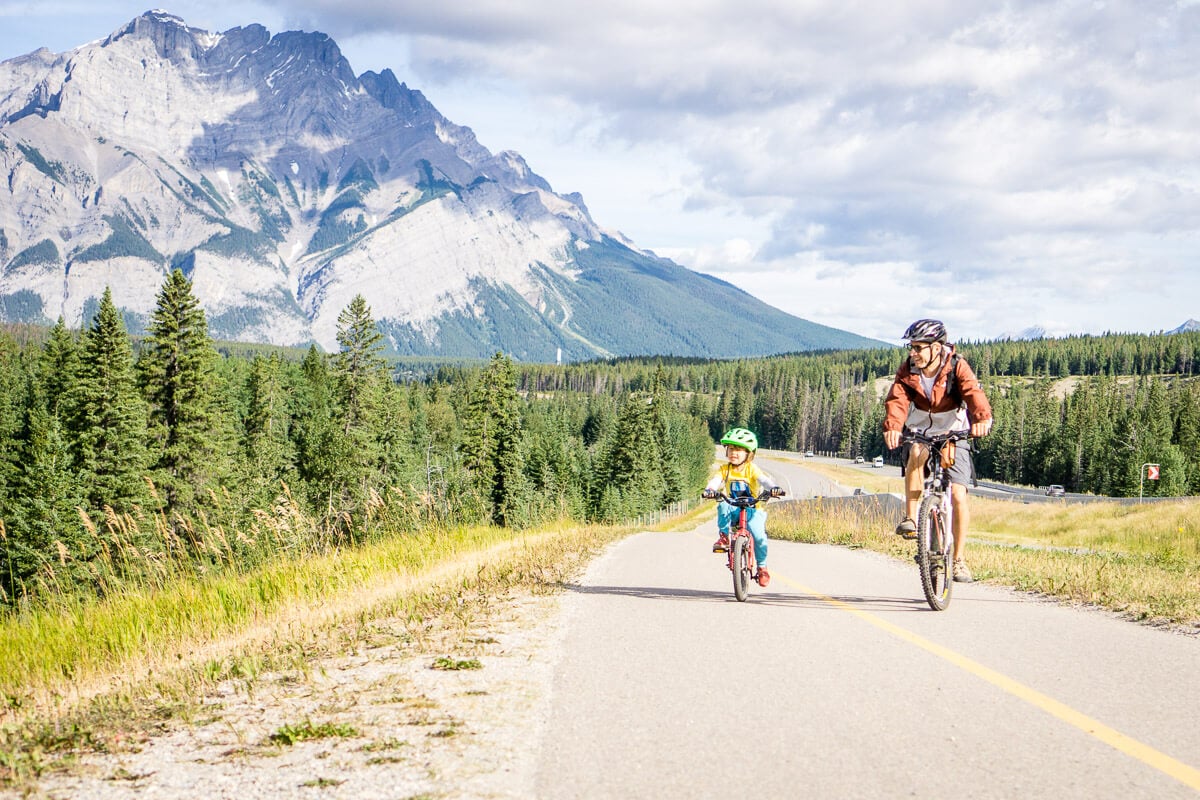
The Rocky Mountain Legacy Trail is undoubtedly the crown jewel of Banff bike trails. This 3-metre-wide paved trail was built to commemorate Parks Canada’s 125th anniversary and has become a must-do cycling experience in Banff National Park. In a nutshell, the Legacy Trail connects Canmore to Banff with incredible mountain views.
Despite paralleling the Trans-Canada Highway for much of its length, the scenery is absolutely spectacular. You’ll glide through dense forests filled with wildflowers, pass beaver-dammed mountain streams, and enjoy unobstructed views of the Canadian Rockies throughout your ride.
Surprisingly flat for a mountain trail, with only 250m of net elevation gain from Canmore to Banff. The ride from Canmore to Banff is more challenging due to the gradual uphill and potential headwinds, while the return trip to Canmore is mostly downhill and much easier.
The downside of this trail is that you’ll need to deal with highway noise for most of it. It will also be extremely busy on a nice summer day.
If the entire distance is too much, you can always use Roam Transit for the return trip. The regional route 3 has a bike rack on the front of the bus. Alternatively, consider renting an e-bike for this longer ride.
Trail Sections:
- Canmore to Banff East Gate: 4.5 km
- Banff Legacy Trail proper: 22.3 km (East Gate to Bow Valley Parkway)
Best Access Points:
- Canmore: Travel Alberta Visitor Information Centre (free parking)
- Valleyview Day Use Area: Great for shorter rides (eastbound highway access only)
- Cascade Ponds: Perfect starting point to avoid Banff townsite traffic
- Banff: Banff Train Station parking (free parking)
Local Tips:
- Start early to avoid crowds and secure parking
- Ride Banff to Canmore for an easier, mostly downhill experience
- Stop at Cascade Ponds for photos and a break
Read More
Read our full Guide to the Banff Legacy Trail here.
2. Bow Valley Parkway Cycling (Highway 1A)
Distance: 48 km one-way (24 km from Banff to Johnston Canyon)
Difficulty: Moderate to Challenging
Surface: Paved road
The Bow Valley Parkway is a secondary highway that runs parallel to the TransCanada highway from Banff to Lake Louise. The entire distance of the Bow Valley Parkway is 48 km.
Thanks to Parks Canada’s extended 5-year cycling pilot project (2025-2030), sections of the scenic Bow Valley Parkway are closed to public vehicle traffic during spring and fall, creating an unparalleled road cycling experience.
While it’s possible to ride the entire road from Banff to Canmore, most recreational cyclists enjoy riding the closed section in the spring and fall. In the summer, the entire road is open to vehicle traffic and is much busier.
If you are comfortable with riding the road with cars, you may want to continue past Johnston Canyon. If you prefer to ride where there is no traffic then spring and fall are the best times for this incredibly scenic ride. You can also pair it with hiking the popular Johnston Canyon for a fun adventure.
Of course, if the distance is too much for you then consider renting an e-bike or joining a tour where you only need to do one direction.
The section of road that’s closed is only 17 km, but by starting in Banff along the Vermilion Lakes road then joining the Legacy Trail before getting on the Bow Valley Parkway, the total distance is increased to 24.5 km for a total return distance of 50 km.
Closure Schedule:
- Spring: May 1 – June 25 (8am-8pm daily)
- Fall: August 28 – October 2 (8am-8pm daily)
- Eastern section only: Fireside Day Use to Johnston Canyon
From Banff: Park at Banff Train Station and ride via Vermilion Lakes Road (50 km round trip to Johnston Canyon)
The Bow Valley Parkway is one of Banff’s best wildlife viewing areas. Bears, elk, and deer are commonly spotted, so ride in groups, carry bear spray, and make noise.
Read More
Read our full Guide to Cycling the Bow Valley Parkway here.

3. Sundance Canyon Trail
Distance: 8 km bike ride + 2 km hiking loop
Difficulty: Easy to Moderate
Surface: Paved trail to trailhead, then hiking trail
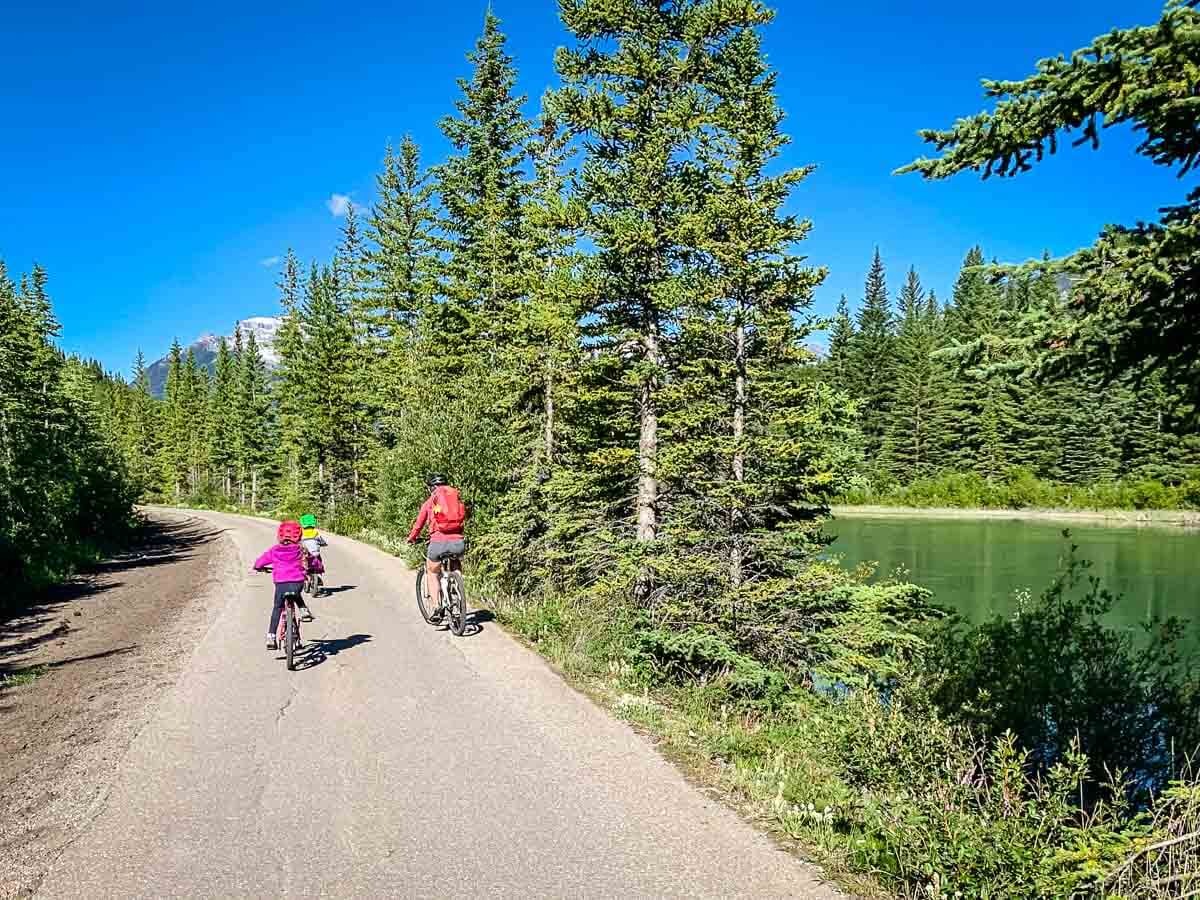
Spectacular canyon and waterfall accessible by bike, this unique trail combines the best of both cycling and hiking. Starting from the historic Cave & Basin site, you’ll enjoy a scenic 4 km bike ride through forest and along the Bow River before reaching the stunning Sundance Canyon hiking trail.
The paved trail begins with a fun, gentle downhill from Cave & Basin, offers beautiful riverside riding, then climbs gradually through forest for the final kilometer to reach the canyon trailhead.
You can either park at the Cave & Basin, or if you are renting bikes, you can get to the trail right from downtown Banff.
Following the Bow River Trail to the Nancy Pauw bridge, you can continue on the pathway past the Sundance Park onto to Sundance Road. Sundance Road is a quiet road past the Warner stables where you can join the pathway on the right as Sundance Road meets Cave Avenue. You’ll eventually want to get off the path and go around the Cave & Basin to join the Sundance Trail.
Lock up your bikes at the provided bike rack and explore the spectacular 2 km Sundance Canyon loop. The trail includes creek crossings on wooden bridges and passes through lush, moss-covered forest.
You’ll even find picnic tables at the start of the hike, so don’t forget snacks and water. There are also picnic spots around the Cave and Basin.
Read More
Read our full Guide to the Sundance Trail in Banff here.
4. Vermilion Lakes Road
Distance: 4.2 km loop
Difficulty: Easy
Surface: Paved road
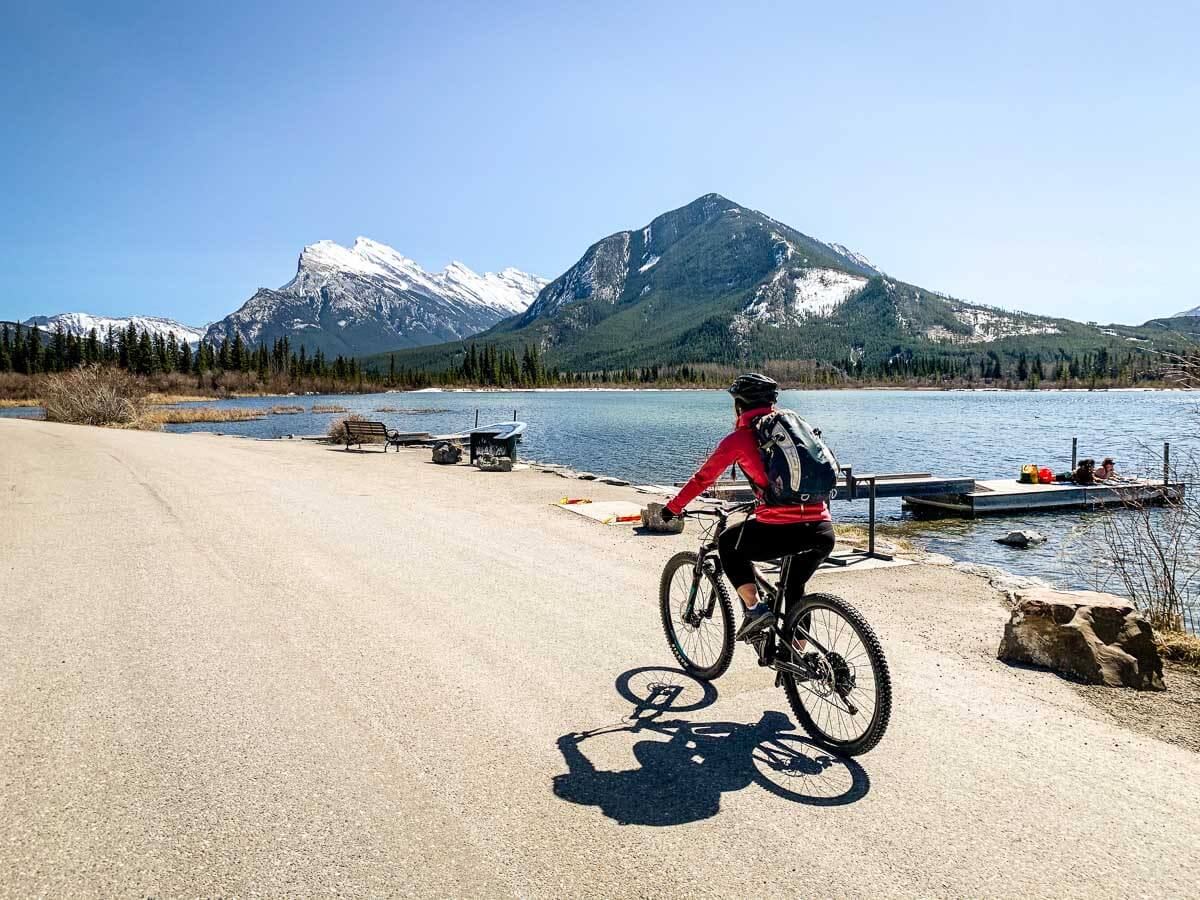
While technically a quiet road rather than a dedicated bike path, Vermilion Lakes Road offers one of the most scenic short rides in Banff. The loop takes you past three beautiful lakes with incredible views of Mount Rundle and the surrounding peaks.
This road is perfect for sunrise or sunset photography and excellent for wildlife viewing. It also connects to the Legacy Trail system that goes towards the Bow Valley Parkway if you want to add to your ride.
While this is a road, it has minimal vehicle traffic. You still want to be aware and follow the rules of the road, as you will see some cars on this road.
Go early morning or evening for the best light and fewer crowds. This is also when wildlife is most active around the lakes.
You can easily park at the Banff Train Station or even the Fenlands Day Use to access this road.
5. Bow River Pathway System
Distance: Various loops and sections (up to 15 km total)
Difficulty: Easy
Surface: Paved pathway
Enjoy peaceful riverside cycling through Banff townsite and beyond. Riding the Bow River pathways is an excellent way to see Banff’s sites.
Banff’s Bow River pathway system offers some of the most relaxing and scenic cycling in the park. These interconnected paved paths follow the meandering Bow River both upstream and downstream from the townsite, providing easy access to beautiful riverside cycling.
The Bow River pathways offer a perfect introduction to cycling in Banff. The gentle, flat surfaces make them accessible to all skill levels, while the riverside location provides constantly changing views of the crystal-clear mountain river, surrounding forest, and distant peaks.
You can enjoy a ride from town along the river to Bow Falls. Just be aware that to get to Bow Falls Viewpoint, you will need to do a section on the road, which is a large hill and can be a struggle for some on the way back.
Starting downtown Banff, you can hit the Bow River Trails to Central Park then on to the Banff Pedestrian Bridge over to Bow Falls. You can add on the Golf Course Road for some extra distance and mountain scenery. From there, you can return on the other side of the river and even join up with other trails like the one to Sundance Canyon. Return on the Nancy Pauw Bridge before returning to town.
Keep an eye out for elk grazing in Central Park, various waterfowl along the river, and occasionally deer in the early morning or evening hours.
Map of Banff’s Best Bike Routes
Best Road Cycling Routes in Banff
6. Lake Minnewanka Loop
Distance: 13.1 km loop (15 km from Cascade Ponds, 21 km with Johnson Lake detour)
Difficulty: Easy to Moderate
Surface: Paved road
This road ride is a multi-lake route past Lake Minnewanka, Two Jack Lake, and Johnson Lake.
It’s a popular road cycling route that takes you on a scenic journey past three beautiful lakes with spectacular mountain views throughout. As one of our favorite road cycling routes in Banff, the Lake Minnewanka Loop offers constantly changing scenery and numerous opportunities to stop and explore.
Starting Options:
- From Banff townsite: Park at the Banff Train Station, cycle through town via Legacy Trail
- From Cascade Ponds: Best option – park and start directly from the scenic drive (our recommendation)
- From Canmore: Add the full Legacy Trail for serious distance cyclists
Cascade Ponds is the perfect starting point with excellent parking and picnic facilities. The views of Cascade Mountain are spectacular here.
From here you can take the loop in either direction. Cycling clockwise (straight at the T-intersection) for the best hill distribution and scenic views. Going counter-clockwise keeps most attractions on your right side, avoiding traffic crossings during busy periods.
Places you can stop along the way:
Lower & Upper Bankhead: Explore the remnants of Banff’s coal mining history. Lower Bankhead offers an easy 1.1 km ghost town trail, while Upper Bankhead provides quieter picnic areas and access to the C Level Cirque hike.
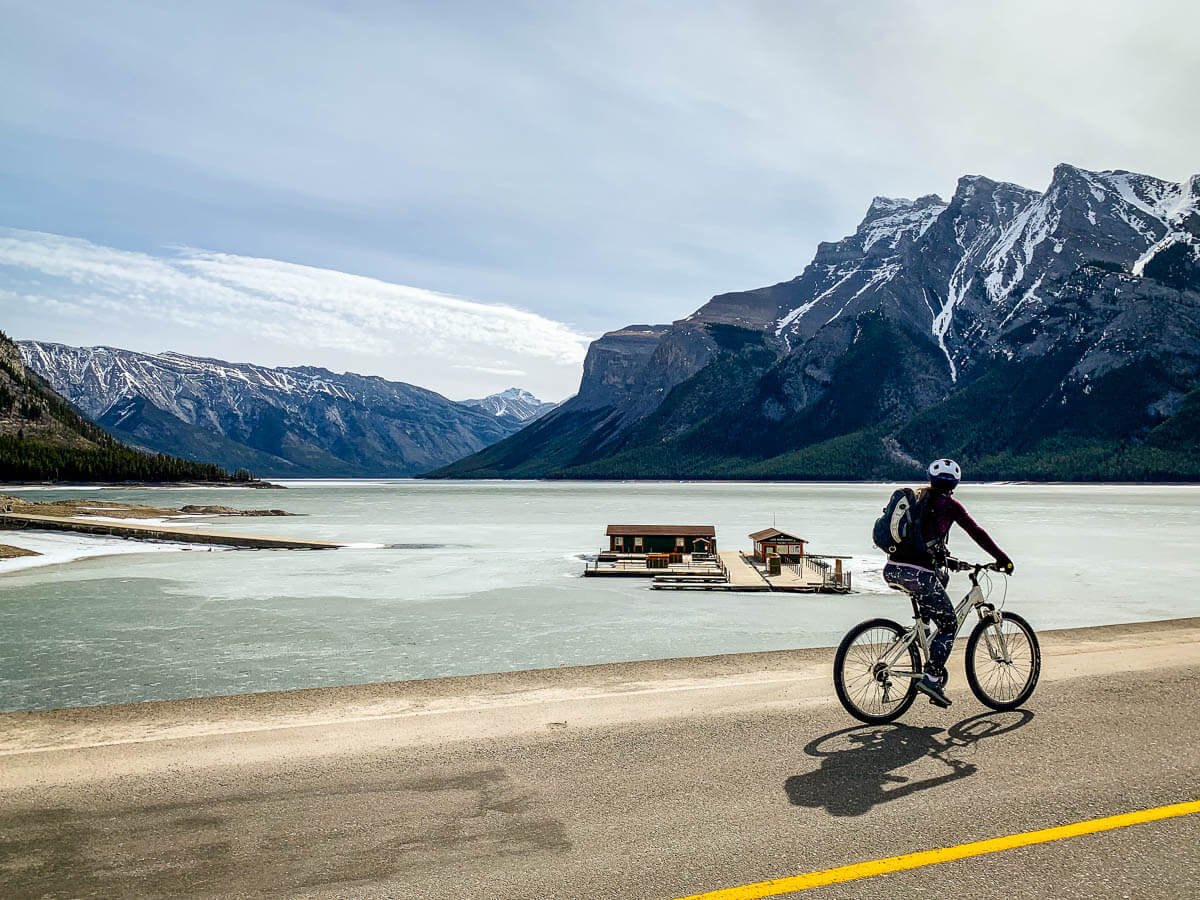
Lake Minnewanka: The star attraction – Canada’s longest lake in a national park. The causeway crossing offers some of the best mountain and lake scenery on the entire route. Consider stopping for the Lake Minnewanka Cruise or Stewart Canyon hike.
Two Jack Lake: One of the most photogenic stops, especially on calm days when Mount Rundle reflects perfectly in the water. The Banff red chairs here make for perfect photo opportunities.
Johnson Lake (optional 6 km detour): Worth the extra distance for its small beach, picnic area and hiking loop.
Despite being in the mountains, we find this loop relatively easy with only 2-3 hills requiring extra effort. From our experience, it takes about 75 minutes from Cascade Ponds, not including stops for photos or exploring.
Keep in mind that this is a busy tourist road with limited shoulders. An early morning would be more ideal than mid-day for this road ride. You are also in prime bear habitat, especially early/late in day – carry bear spray and ride in groups.
We don’t recommend this ride for kids due to the busyness and traffic on this road.
Read More
Read our full Guide to Cycling the Lake Minnewanka Loop here.

7. Moraine Lake Road
Distance: 14.5 km one-way
Difficulty: Challenging (steep, sustained climb)
Surface: Paved road
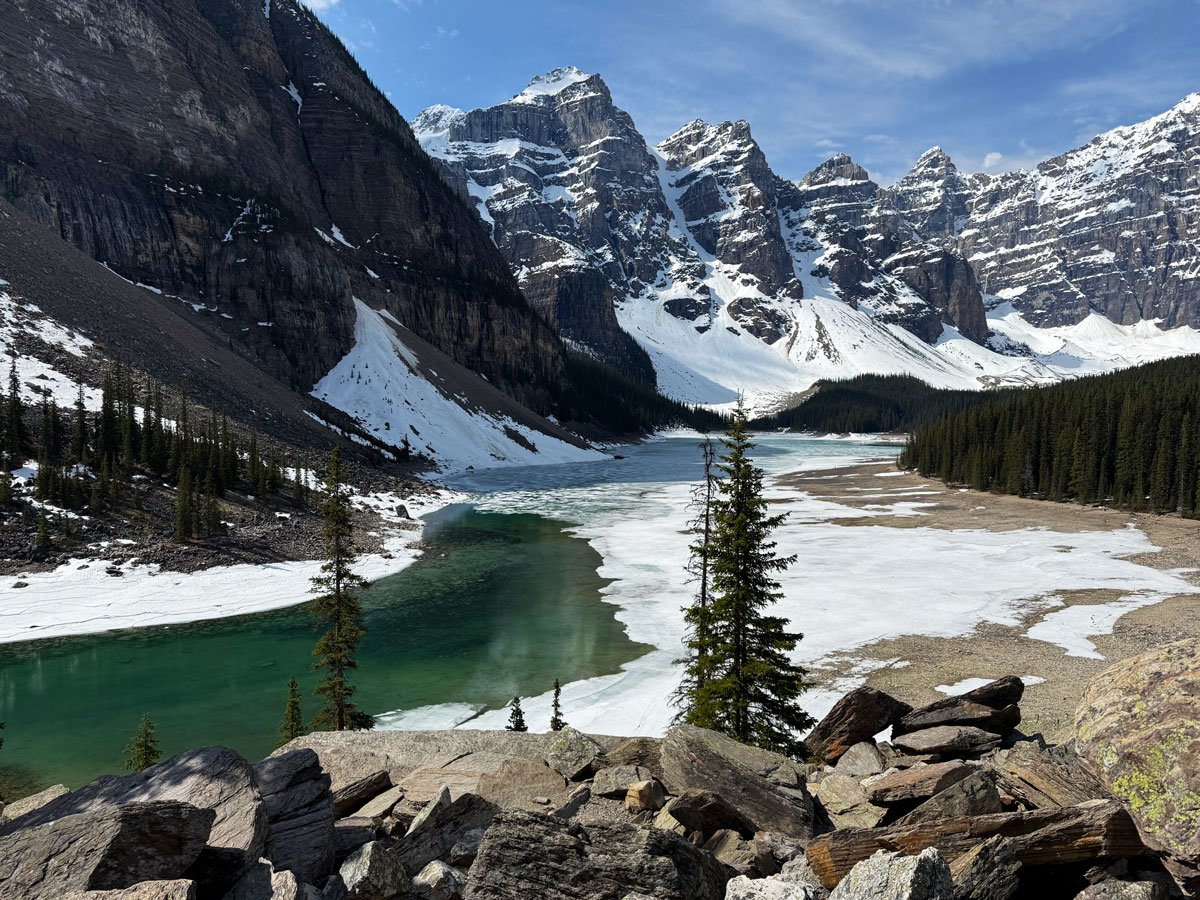
Moraine Lake Road offers one of the most rewarding cycling experiences in Banff, especially during the magical window in late May when the road is plowed and open but shuttle service hasn’t started yet.
Moraine Lake Road is typically cleared of snow by late May, but the mandatory shuttle system doesn’t begin until June. This gives cyclists a rare opportunity to experience one of the world’s most photographed lakes without the summer crowds.
Expect a sustained uphill ride as you go from the small parking area to the lake. It’s challenging but manageable for intermediate cyclists. Most visitors who aren’t used to the elevation can rent e-bikes for this enjoyable road ride.
The payoff is worth it! Not only do you get incredible mountain scenery along the way, Moraine Lake, nestled in the Valley of the Ten Peaks, offers arguably the most spectacular mountain scenery in the Canadian Rockies.
You should expect the water levels of Moraine Lake to be fairly low at this time and it might even still be frozen. It’s still well worth the effort!
During this late May timeframe, there’s a small parking lot at the beginning of Moraine Lake Road where you can park to start the ride. Alternatively, there’s a day use parking lot up further along Lake Louise Drive.
You can also start in Lake Louise Village, leaving you with two options: either ride up Lake Louise Drive which is narrow and has no shoulder or take the Tramline trail which is better for mountain bikers.
It’s important that you bring layers for this ride. It can get especially cold on the ride back down. Always make sure the road is cleared of snow and there is no longer any avalanche danger before attempting this ride. Finally, this is grizzly bear territory so bring bear spray and travel in groups.
Bike rentals can be found in the Lake Louise Village at Wilson Mountain Sports.
You can bike Moraine Lake Road during the summer (June-September) as well, but it’s a narrow road and will have a lot of shuttles/buses going back and forth. Make sure you are comfortable with this before riding up Moraine Lake Road.
8. Tunnel Mountain Road
Distance: 3.6 km one-way
Difficulty: Moderate (steep climb)
Surface: Paved road
This short but challenging climb takes you up Tunnel Mountain Road to the campgrounds and provides some of the best viewpoints over the Bow River and the surrounding valley.
This would be a great addition to some of the other townsite routes. It’s well worth it to stop at the Hoodoos Viewpoint and Surprise Corner Viewpoint.
You can even combine this with a quick Tunnel Campground loop. You’ll pass through pine forest and might spot wildlife near the campsites. It’s one of the least crowded cycling spots near town.
Keep in mind that this road is shared with vehicles, so you’ll want to follow all the rules of the road. Wildlife is often found along this road (especially elk) so be sure to keep your distance.

9. Icefields Parkway (Highway 93 North)
Distance: 230 km one-way to Jasper (or shorter sections)
Difficulty: Challenging
Surface: Paved highway
One of the world’s most scenic drives is also incredible for road cycling.
The Icefields Parkway is considered one of the most beautiful roads in the world, and cycling sections of it offers an unforgettable experience. While the full distance to Jasper is an epic multi-day adventure, even shorter sections provide world-class road cycling.
For those serious road cyclists, some popular sections are:
- Banff to Saskatchewan River Crossing: 77 km with spectacular glacier views
- Lake Louise to Bow Lake: 37 km featuring Peyto Lake and Bow Lake
- Bow Lake to Saskatchewan River Crossing: 40 km through some of the most dramatic mountain scenery
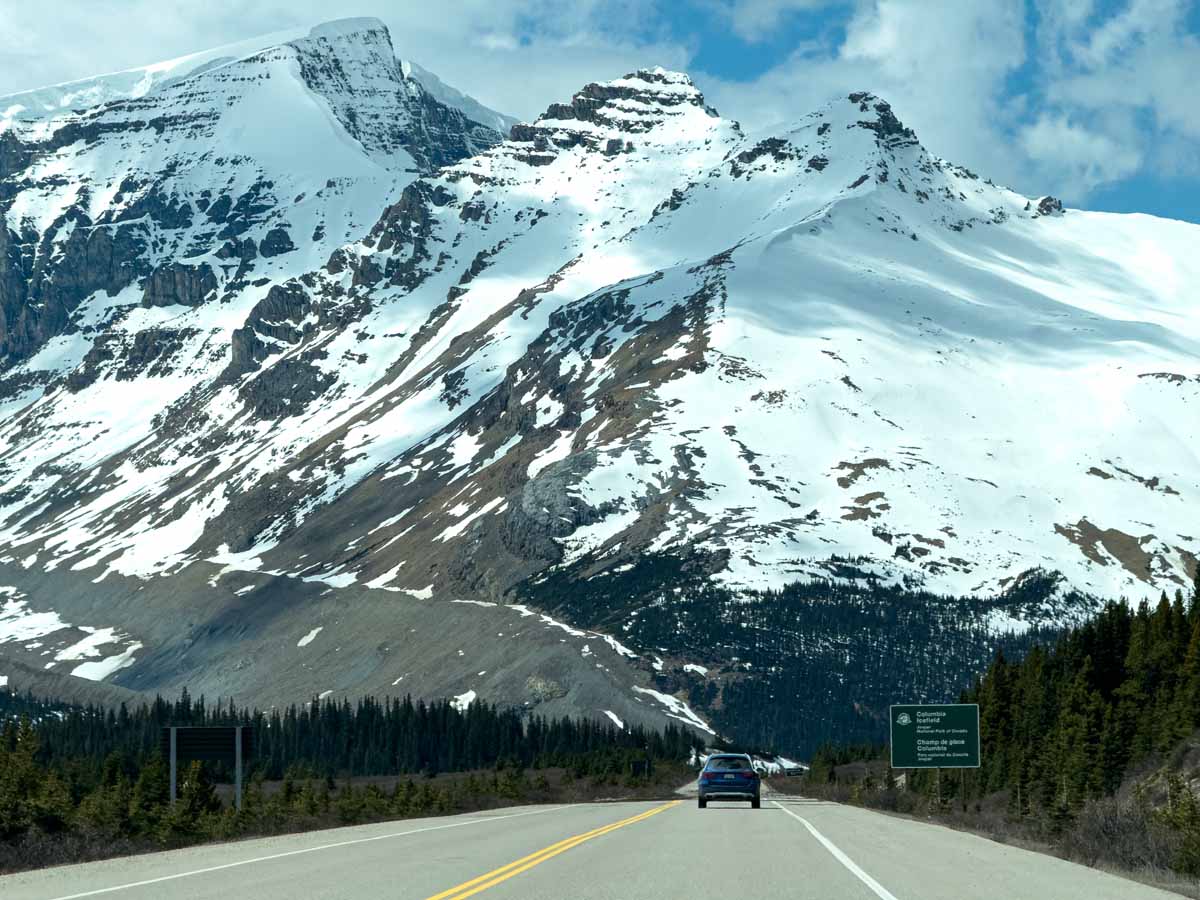
The Icefields Parkway takes you past massive glaciers, turquoise lakes, and towering peaks. You’ll cycle alongside the Mistaya River, see Peyto Lake’s incredible blue waters, and witness glaciers tumbling down from the Columbia Icefield.
This one isn’t just a leisurely bike ride, you’ll be on a road with fast moving traffic and no cell service. This one is best for experienced road cyclists.
This is a major tourist route, so start very early. The weather can change quickly. Plan carefully and have support or shuttle arrangements. You’ll also want to carry extra food and water. Be prepared for some significant climbs!
Many cyclists arrange for vehicle support or one-way shuttles to avoid the long return journey. The scenery is so spectacular that even cycling just to Bow Lake and back makes for an incredible day.
Essential Tips for Cycling in Banff
The key to enjoying Banff’s bike trails is planning ahead, starting early, and taking time to appreciate the incredible mountain scenery around you. Whether you’re seeking a leisurely ride or an epic cycling challenge, Banff’s diverse trail system will exceed your expectations.
If you aren’t comfortable navigating on your own or would like some extra support, there are some incredible bike tours in and around Banff.
We see many cyclists around town that don’t wear helmets. You should definitely be wearing a helmet any time you are cycling, but especially if you are on roads or riding an e-bike.
For many of these rides, you’ll want to carry bear spray in an easily accessible location and ride in groups whenever possible. Make noise on blind corners and in dense forest sections.
Of course, you’ll want to follow trail etiquette and yield to other users.

What to Bring for Biking in Banff
- Water and snacks – mountain air is dehydrating
- Layers – mountain weather changes quickly
- Gloves – especially important if you are riding in the spring or fall
- Bike lock so you can secure your bike and enjoy exploring the areas
- First aid kit and basic repair tools
- Sunscreen and hat – UV is stronger at altitude
- Rain jacket – weather can change rapidly
Bike Rentals in Banff
If you need to rent bikes, these local shops offer quality equipment:
- Ultimate Sports
- Snowtips Bactrax
- Bear Street Outfitters
- Bike Banff Rentals (at the Banff Train Station)
- Banff Cycle & Sport
These and even more shops in town rent bikes, e-bikes, kids bikes and even bike trailers.
Remember that you’re cycling through one of the world’s most beautiful wilderness areas. Take the time to enjoy every moment!
Love our content? Sharing our post is the easiest way to support us!

Celine Brewer, a local Canmore resident, is the co-owner of Travel Banff Canada. She has a passion for being out in the mountains any time of year. In the summer, you'll often find her hiking or mountain biking. In the winter, she enjoys cross-country skiing, snowshoeing and winter hiking the most.
As much as she loves the mountains, she also loves travel! When she's not playing outdoors at home, she's either traveling the world with her husband and two kids or working on their other two travel sites: Family Can Travel and Baby Can Travel.