Winter completely changes the feel of Banff National Park, with snow-covered forests, frozen lakes and mountain peaks stretching above the valley. On a clear day, snowshoeing in Banff is one of our favourite ways to get outside and enjoy the Rockies. The best Banff snowshoe trails range from short, family-friendly outings to longer routes with bigger climbs and mountain views, so there are good options for almost every ability level.
We’ve been snowshoeing in the Canadian Rockies for 17+ years, first while living in Calgary and now as Canmore locals. One thing we’ve learned is that trail conditions matter just as much as the trail itself. Some routes can have deep, fresh snow after a snowfall, while popular trails may be packed down enough that microspikes are more useful than snowshoes. We usually bring both so we can adjust once we see the conditions.
In this guide, we’re sharing the Banff snowshoe trails we think are most worth considering, including easy options, moderate routes and a few longer outings for stronger hikers. We’ll also cover what to expect on each trail, when snowshoes are actually useful and a few important winter safety tips.
If you’re looking for even more places to get out in the snow, we also have separate guides to the Lake Louise Snowshoe Trails and our favourite Kananaskis Snowshoe Trails. Both areas offer plenty of additional options and are well worth considering if you have more time in the Canadian Rockies.

This post contains compensated links.
Planning a Winter Trip to Banff?
The Banff & Jasper Planning Hub includes our Banff Winter Travel Guide, with practical winter advice, activity ideas, seasonal tips, and local guidance to help you plan your trip without feeling overwhelmed.
6 Banff Snowshoe Trails
Each of these Banff snowshoe trails are among our favourites in the national park. We’ve included easy and moderate snowshoe trails in Banff and one that’s more of a challenge.
1. Johnson Lake Snowshoe Trail
Distance: 2.8 km loop, Elevation Gain: minimal.
For an easy snowshoe in Banff, you can’t beat the Johnson Lake trail. It’s a short loop around the lake with impressive views of Mount Rundle and Cascade Mountain.

From the parking lot, walking down to the lake and across the bridge will take you through the forested section first. On this side, the trail keeps you close to the shoreline.

The benefit of doing the forested section first, is that the return trip on the other side of the lake will give views of Cascade Mountain the entire time as you walk towards it.

Shortly after crossing the bridge at the far side of Johnson Lake, there are two options.
One trail is higher up along the ridge and offers much more impressive views. Meanwhile, the second trail stays down lower close to the lakeshore. This trail is narrow and can be difficult to pass when meeting other people on the trail.

Read More
Parks Canada has placed red chairs at some of the most scenic spots in the national park. Find them all with our list of the Parks Canada Red Chairs in Banff.
This easy Banff snowshoe trail is a perfect spot for snowshoeing with kids. If the lake is sufficiently frozen, the surface of the lake is a fun place to try snowshoeing in the deep snow. Ensure you take all the proper precautions and test the ice thickness before venturing on to the lake. Parks Canada recommends at least 15 cm of ice for walking or skating alone.
Johnson Lake is popular in the winter for both skating in Banff and as an easy winter hike in Banff. It’s possible that the path will be packed down enough that microspikes are sufficient.
Want more details? Read our complete guide to the Johnson Lake Trail for the trail map, directions, parking information and everything you need to plan your snowshoe.

Read More
Wondering if a trip to Banff is worth it in winter? See why we love it so much in our guide to the best time of year to visit Banff.
2. Moose Meadows to Johnston Canyon Upper Falls Snowshoe
Distance: 7.4 km out and back, Elevation Gain: 298 m to Upper Falls
If you want to actually snowshoe to Johnston Canyon, rather than simply walk the icy canyon trail, start at the Moose Meadows/Johnston Creek trailhead on the Bow Valley Parkway. This quieter route follows a forested trail from Moose Meadows before joining the Johnston Canyon trail near the Upper Falls.
We like this option for snowshoeing to Johnston Canyon because the Moose Meadows section is a true Banff snowshoe trail. You spend most of the outing travelling through the forest, away from the busy catwalks and crowds at Johnston Canyon. After roughly 3 km, the trail reaches the junction with the main Johnston Canyon route. Turn toward the canyon to visit the Upper Falls before returning the same way to Moose Meadows.

Once you reach Johnston Canyon, conditions usually change considerably. The main canyon trail is often hard-packed and very icy, so snowshoes are rarely the best footwear for this portion.
It’s important you know about your winter traction options before hitting the snowy or icy winter trails. We recommend carrying microspikes and switching to them before heading down toward the Upper Falls.
The Upper Falls are well worth the extra effort, especially in the middle of winter when the 30 m waterfall is frozen. From the junction, you’ll descend into the canyon and follow the trail to the Upper Falls before climbing back out and retracing your route through Moose Meadows.

Good to Know: Snow conditions can make a big difference on the Moose Meadows trail. After fresh snow, snowshoes may be very useful, while a well-packed trail may only require microspikes. We usually carry both when doing winter trails like this so we can adjust to the conditions.
Need a trail map? See the Moose Meadows Trail on AllTrails for the route map, trailhead location and directions.

Banff App Pick: AllTrails
AllTrails is one of our most recommended apps for visiting Banff, and your trip is the perfect time to try AllTrails Plus. Start with the 7-day free trial to download maps, save hikes, and use premium features before heading into the mountains.
Johnston Canyon Icewalk
If your main goal is to see the frozen waterfalls at Johnston Canyon rather than go snowshoeing, you don’t need to start at Moose Meadows. The regular Johnston Canyon trail from the day-use area is one of the most popular winter walks in Banff National Park and reaches the Upper Falls after about 2.5 km one way. The trail follows the canyon on wide paths and narrow catwalks, but it can be extremely icy, so winter hiking traction devices are strongly recommended.

It’s easy to do the Johnston Canyon icewalk independently with proper winter footwear and traction, but guided icewalk tours are also very popular. A guided tour can be a good option if you don’t have winter gear, don’t want to worry about driving or simply prefer having a guide explain the canyon and frozen waterfalls along the way. One of the established Johnston Canyon Icewalk tours runs through the winter season and includes a guided walk to the Upper Falls.
3. Ink Pots via Moose Meadows
Distance: 11.2 km out and back, Elevation Gain: 340 m.
If you’d like to continue your Banff snowshoeing adventure beyond Moose Meadows, another trail we really enjoy is the Ink Pots Trail. The Ink Pots are a series of mineral-rich springs with blue-green water bubbling up through the sandy bottom. They are found in a valley surrounded with impressive mountain views.
To snowshoe to the Ink Pots, simply stay on the Moose Meadows snowshoe trail. We typically veer off the Moose Meadows Trail to visit the frozen Upper Falls of Johnston Canyon, before returning to the trail to continue snowshoeing to the Ink Pots.

Once back at the junction, follow the sign to the left to the Ink Pots. The snowshoeing trail is easy to follow as it climbs through the forest. As you near the Ink Pots, you’ll lose some elevation as you descend into the valley. Eventually, the forest opens up to a stunning alpine meadow.

While the Ink Pots won’t be nearly as impressive in the winter, the surrounding scenery is more than worth it. If the Ink Pots aren’t frozen over, you may still get the green/blue hue, best seen on a sunny day.

The benches at the Ink Pots make the perfect spot to stop and enjoy this beautiful winter scenery in Banff. Take the same trail back down to the parking lot, enjoying the downhill almost the entire way.
Want more details? Read our complete guide to the Ink Pots Trail for the trail map, directions, parking information and everything you need to plan your snowshoe. It looks like a summer post, but keep reading for all the information you need about enjoying this trail in winter.

Let me Help with Your Banff Itinerary?
We have a suite of Banff Travel Planning services that can take all the guesswork out of planning your trip! Book a 1 hour travel consultation or let me create a custom Banff Itinerary for you!
4. Upper Stoney Lookout Trail
Distance: 4.8 km loop, Elevation Gain: 205 m.
The Upper Stoney Loop at Mount Norquay makes for a fun half-day snowshoe in Banff National Park. This trail isn’t overly long, but due to the elevation gain we would classify it as one of the moderate snowshoe trails in Banff.

The trail starts at the end of the Mount Norquay Ski Resort parking lot closest to the access road and begins climbing almost immediately. It’s a continual climb, with a few steep sections, through the forest. I often think the forest on this trail is one of the prettiest winter forests in all of Banff National Park/

The trail is easy to follow as it’s used frequently by snowshoers, hikers and people fat biking in Banff. If the trail is well packed, you may not need snowshoes, though winter hiking traction devices will make the climb easier.
If you are snowshoeing the Upper Stoney Loop shortly after a large snowfall, definitely pack snowshoes. It’s not unusual for the first half of the trail to be packed down by a hiker who turned back. You’ll be breaking trail if you continue the loop, especially early in the season.
There aren’t many views on the climb, but you’ll be rewarded with one at the lookout. The trees hide most of the view, but this is still a great place to stop for lunch or a snack.

From there continue along the same trail to loop back down. The trail will end at the Mount Norquay Ski Resort where you walk across the parking lot to finish this moderate Banff snowshoe trail.
We have enjoyed this snowshoe trail in Banff many times with our kids. While there might be some complaining on the way up, they’ll love the second half that’s almost entirely downhill!
Want more details? Read our complete guide to the Upper Stoney Snowshoe Trail for the trail map, directions, parking information and everything you need to plan your snowshoe.

Read More
There is much more on your winter vacation to Banff than snowshoeing. Fill out your itinerary with the best things to do in Banff in winter.
5. Hoodoos Viewpoint via Surprise Corner
Distance: 9.6 km out and back, Elevation Gain: 305 m.
As with many winter trails around Banff, whether you need snowshoes on the Hoodoos to Surprise Corner Trail depends on how much snow has fallen recently. This trail is close to the Town of Banff, and is frequented by locals and tourists. This means the trail is often packed down within days of a recent snowfall. We find it helps to plan for either a snowshoe or a winter hike.
This snowshoeing trail starts at Surprise Corner, with an excellent view of the Fairmont Banff Springs.

From there it’s an easy walk along the Bow River with just as impressive views of Mount Rundle. There is one steep hill along this trail, but it’s well worth it for the views from the Hoodoo Viewpoint.
This is one section where even with little snow, you should be prepared with some type of winter traction device for your boots (either snowshoes or microspikes).
This trail can be done as a loop by heading back on Tunnel Mountain Road, but we prefer it as an out and back. The trail down by the river is quiet and peaceful.
Want more details? Read our complete guide to the Surprise Corner to the Banff Hoodoos Trail for the trail map, directions, parking information and everything you need to plan your snowshoe. It’s mostly a summer-focused post, but all the details you need are in there.

6. Cascade Amphitheatre Snowshoe
Distance: 12.8 km out and back , Elevation Gain: 885 m.
If you are looking for a challenging snowshoe trail in Banff, try the Cascade Amphitheatre snowshoe trail. Beginning at the Mount Norquay Ski Resort, follow the snowshoe trail signs that begin near the Sundance Magic Carpet and follow them past the chair lifts. You’ll eventually descend down into the trees near the Mystic chairlift.

This Banff snowshoe trail starts with a descent down to the Forty-Mile Creek. Enjoy this part of the trail, as the trail past the bridge starts its ascent all the way to Cascade Amphitheatre.

After crossing the bridge over Forty-Mile Creek, you’ll get a few mountain views through the trees. These are a great place to stop and catch your breath.
The trail will eventually come to a junction where you’ll continue to the right. This is where the switchbacks start to get steeper. You’ll be glad you aren’t the ones breaking trail on this climb. Even if the trail is packed, the snow can still be soft and snowshoes provide good traction.

The switchbacks continue through the sparse forest before the trail levels off and the trees become denser. From there you’ll know you’re close, as it soon opens up to reveal the view you came looking for!

For several years, most of our snowshoeing involved shorter outings with our kids. We’ve spent a lot of time snowshoeing with kids, either carrying them in a backpack carrier or with them snowshoeing themselves.
With our kids in ski lessons at Norquay, we started exploring the surrounding trails and knew we wanted to complete this snowshoe trail all the way to the Cascade Amphitheatre. We are so glad we did.

To extend your outing, start with the Upper Stoney Loop then, rather than returning to the parking lot, go right to continue to Cascade Amphitheatre.
Want more details? Read our complete guide to the Cascade Amphitheatre Snowshoe Trail for the trail map, directions, parking information and everything you need to plan your snowshoe.

Snowshoeing in Lake Louise
Lake Louise is one of the best places for snowshoeing in Banff National Park, with enough worthwhile trails that we’ve given it a complete guide of its own. You’ll find everything from short, easy outings near the lakeshore to longer routes that are better suited to experienced winter hikers.
If Lake Louise is part of your winter itinerary, be sure to read our guide to the best snowshoe trails in Lake Louise. It covers the main routes, difficulty levels, trail distances and important winter safety considerations to help you choose the best trail for your day.
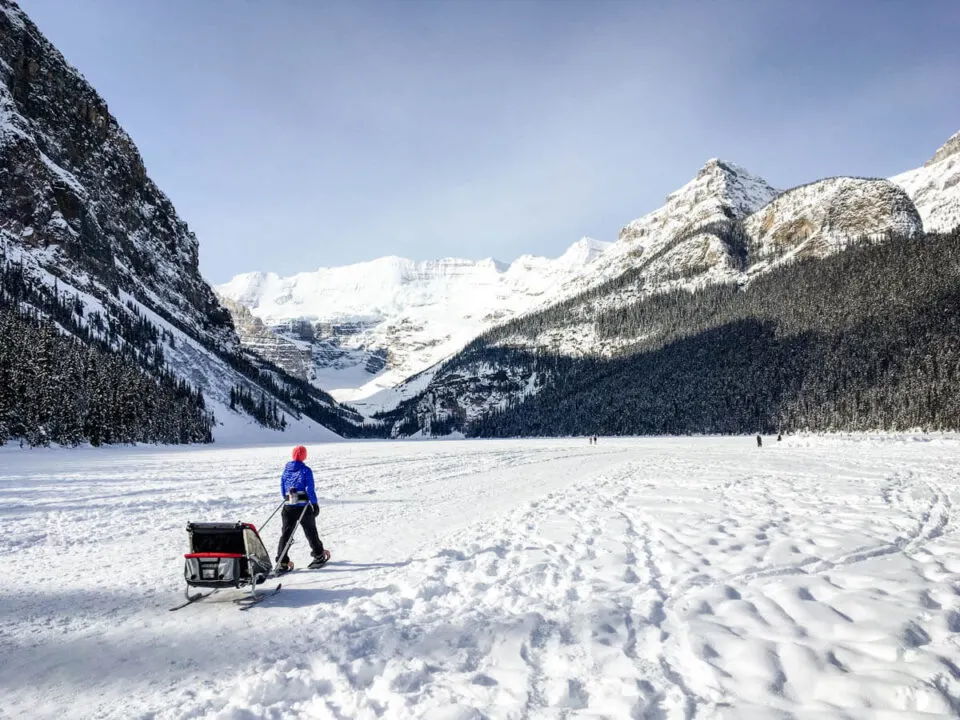

Need Help Planning Your Banff Winter Itinerary?
The Banff & Jasper Planning Hub includes our 7-Day Banff Winter Itinerary, built from years of exploring Banff in winter to help you plan a realistic, well-paced trip.
Banff Snowshoe Trail Safety
Banff Wildlife Safety
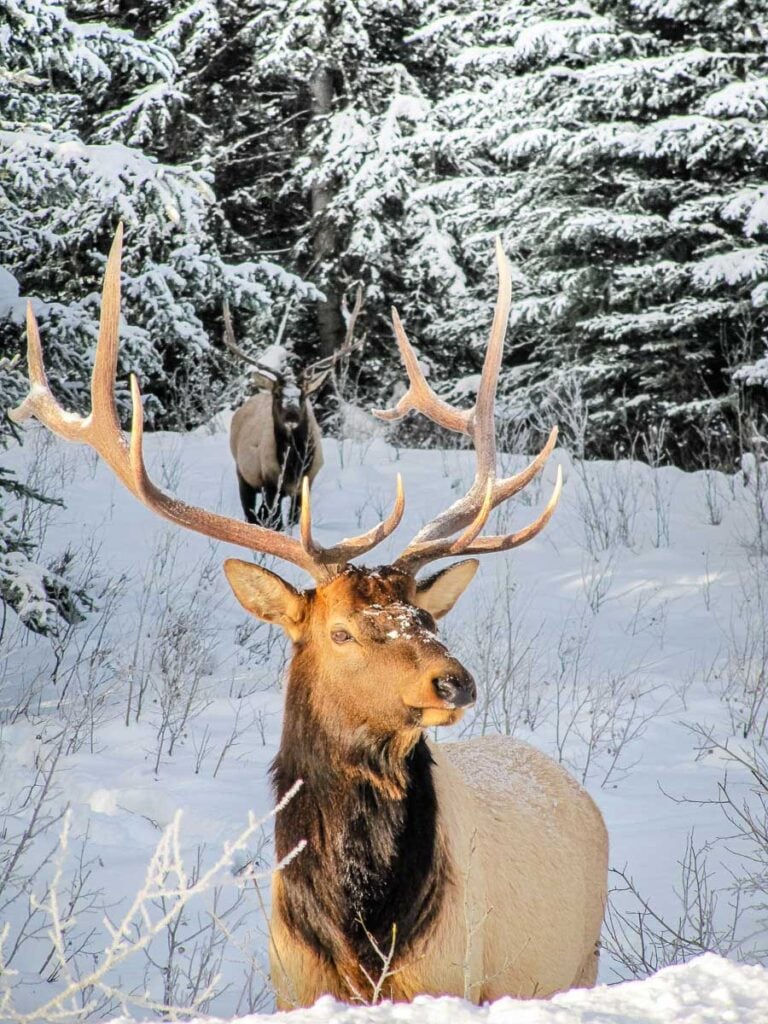
In the dead of winter, the bears around Banff should be hibernating. That doesn’t mean you should let your guard down. Wildlife such as wolves, cougars and elk can still be encountered in winter.
Although the most vicious animal we usually encounter on these Banff snowshoe trails is a squirrel, it only takes a few minutes to learn about wildlife safety in Banff National Park.
Banff Snowshoe Trail Reports
It’s always a good idea to check the Banff snowshoe trail conditions before you leave home. Parks Canada doesn’t publish conditions for every trail, so recent AllTrails reviews can also give you an idea of what to expect.

Avalanche Risk while Snowshoeing in Banff National Park
Avalanche terrain exists throughout Banff National Park, including below treeline. Avalanche season typically extends from November to June.
We highly recommend consulting the current Banff avalanche forecast prepared by Parks Canada before you go.
We are not avalanche experts, so please educate yourself and make smart decisions while enjoying the beauty of Banff National Park in winter.
| TRAVEL BANFF CANADA
────────────── • ──────────────
Have so many Banff ideas…
but not sure how they fit together?
You can save every post, read every comment, and still not know what’s realistic in one day. The Banff & Jasper Planning Hub helps you connect the lakes, hikes, shuttles, scenic drives, restaurants, and Jasper days into one clear plan.
Workshops
Itineraries
Shuttle help
Restaurants
Discounts
Explore the Banff & Jasper Planning Hub
Essential Tips for Snowshoeing in Banff
The most important thing about snowshoeing in Banff is to know the terrain, stay safe and be prepared for the elements.
Always check the weather forecast and be prepared to turn back if the weather changes for the worse. The weather can change quickly in the mountains and blowing snow can cause zero visibility.
Be aware of the terrain you are snowshoeing into and only venture into avalanche terrain if you know what you are doing. Learn the avalanche basics from Avalanche Canada.
Dress in layers so you can remove clothing as you warm up and avoid getting sweaty. Keeping yourself and your feet dry will help you stay warmer throughout the day. We recommend learning about dressing in layers before you enjoy any snowshoe trails in Banff. We cover this in detail in our Banff winter packing list.
Winter days are short, and it can get dark surprisingly early when the sun drops behind the mountains. Plan your snowshoe earlier in the day. Plan your winter hikes earlier in the day.
Bring plenty of snacks and water. Pack snacks that won’t freeze (or are still easy to eat when they get cold). For water, you might need to use water bottles instead of a water reservoir, as the water in the tube can freeze easily.
Sometimes the snowshoe trails are well travelled and the snow is hard-packed. In this case, an alternate winter traction device (such as microspikes) might be easier and more enjoyable to wear.
Support Human Created Content

Hi, we’re Dan & Celine Brewer, locals from just outside Banff National Park. Every article, itinerary, and recommendation we share is rooted in our real experiences and love for this place. If you’ve found our content helpful, please consider supporting us:
- Make a small donation: Your support directly fuels our work and keeps our stories genuine.
- Purchase a guide or itinerary: Essential tools that help plan your trip and support local creators at the same time.
- Book lodging or tours through our affiliate links: You pay the same price, but we earn a small commission that helps us keep producing content.
Thank you for valuing authentic, human-created content. Your support allows us to help even more Banff travellers!
Love our content? Sharing our post is the easiest way to support us!


Celine Brewer, a local Canmore resident, is the co-owner of Travel Banff Canada. She has a passion for being out in the mountains any time of year. In the summer, you'll often find her hiking or mountain biking. In the winter, she enjoys cross-country skiing, snowshoeing and winter hiking the most.
As much as she loves the mountains, she also loves travel! When she's not playing outdoors at home, she's either traveling the world with her husband and two kids or working on their other two travel sites: Family Can Travel and Baby Can Travel.