For a few special weeks every fall, Alberta hikers go a little crazy for golden larch trees. Some of the most popular larch hikes near Calgary have parking lots filling before dawn, while trails in Banff and Kananaskis turn bright gold for a short window each September. As Canmore locals, we look forward to larch season every year, and the Larch Valley hike at Moraine Lake is still one of the most iconic larch hikes near Calgary for good reason.
If you are visiting Banff in September, especially in the second half of the month, this is the time of year when you have the best chance of seeing the larch trees turn golden. Unlike most conifers, larches are deciduous, which means their soft green needles change to a brilliant golden colour before falling to the ground. The exact timing varies each year, but peak colour typically falls somewhere between mid-September and early October.
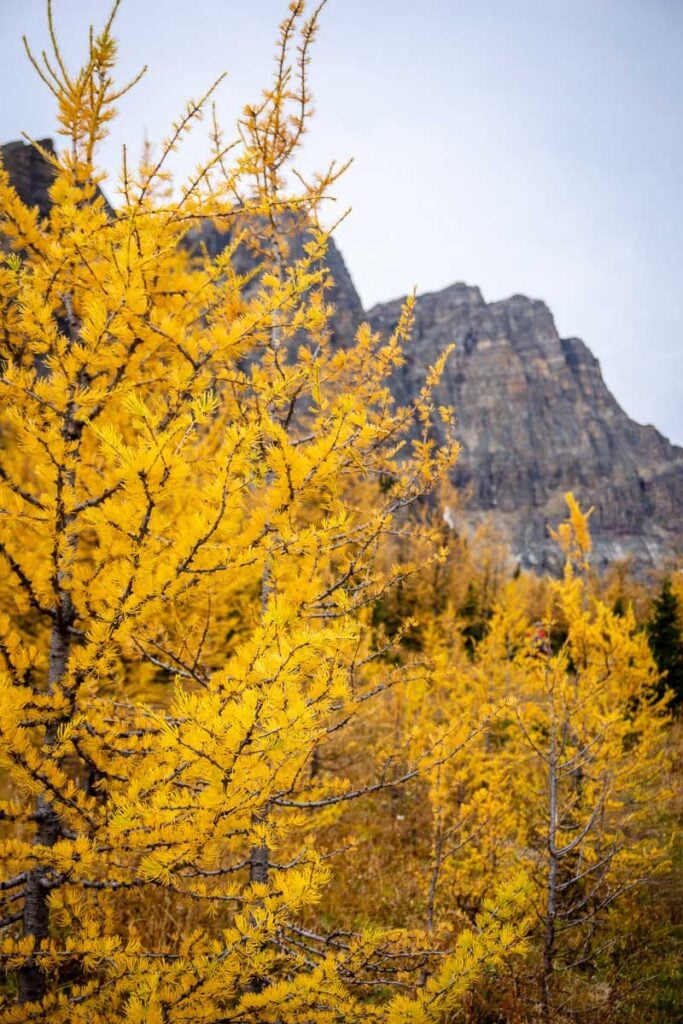
You can find larches throughout Alberta’s mountain parks, including Banff National Park and Kananaskis Country, with everything from easy larch hikes to long, challenging days in the alpine. A few trails get most of the attention, but you definitely do not need to hike Larch Valley to have an incredible larch experience.
In this guide, we’re sharing our favourite larch hikes in Alberta, including the best larch hikes in Banff and Kananaskis, easier options, quieter alternatives and a few places where you can see golden larches without doing a big hike. We’ve hiked these trails ourselves, many more than once, and we’ll help you decide which ones are worth the effort based on difficulty, scenery, crowds and access.

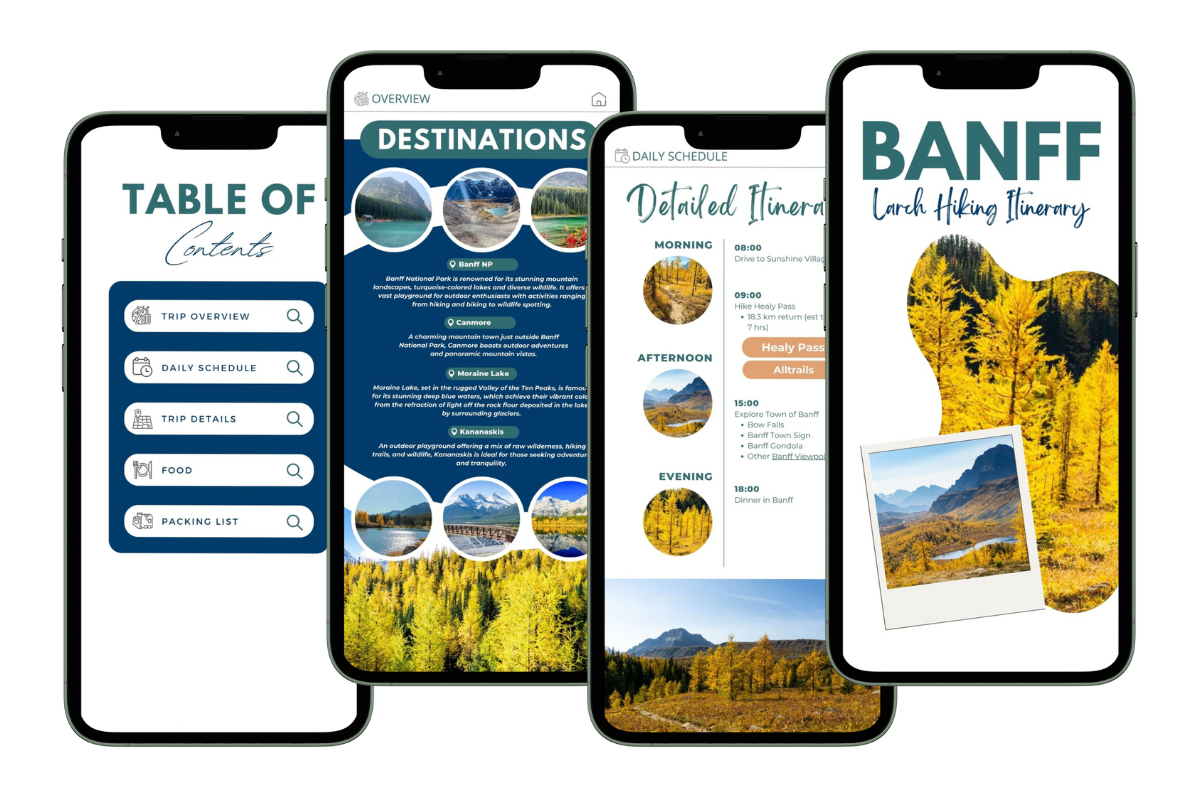
Need Help with Your Banff Itinerary?
Get our 4 Day Banff Larch Hiking Itinerary. In this mobile friendly itinerary, we share our favourite larch hikes in the area, PLUS everything else you need to plan your trip.
This post contains compensated links.
Prefer to listen instead? I recorded a podcast episode on The Banff Travel Podcast all about Alberta’s best larch hikes with insider tips on when to go and how to avoid crowds.
Best Larch Hikes at Moraine Lake
Moraine Lake is home to the Larch Valley Trail, which as already discussed, is the most iconic larch hike near Calgary. But, if you’d like to avoid the crowds associated with Larch Valley, we have a few other larch hikes in Moraine Lake for you to consider.
Here are the best larch hikes in Moraine Lake:
Larch Valley Hike
The Larch Valley hike is by far the most well-known larch hike in Alberta. Located in the exceptionally beautiful Moraine Lake area, hiking Larch Valley during peak larch season is an experience you won’t soon forget.
Larch Valley Hike Stats
Distance: 8.6 km / 5.3 miles out-and-back
Elevation Gain: 535 m / 1,755 ft
Difficulty: Moderate
Time Required: 3-4 hours round-trip
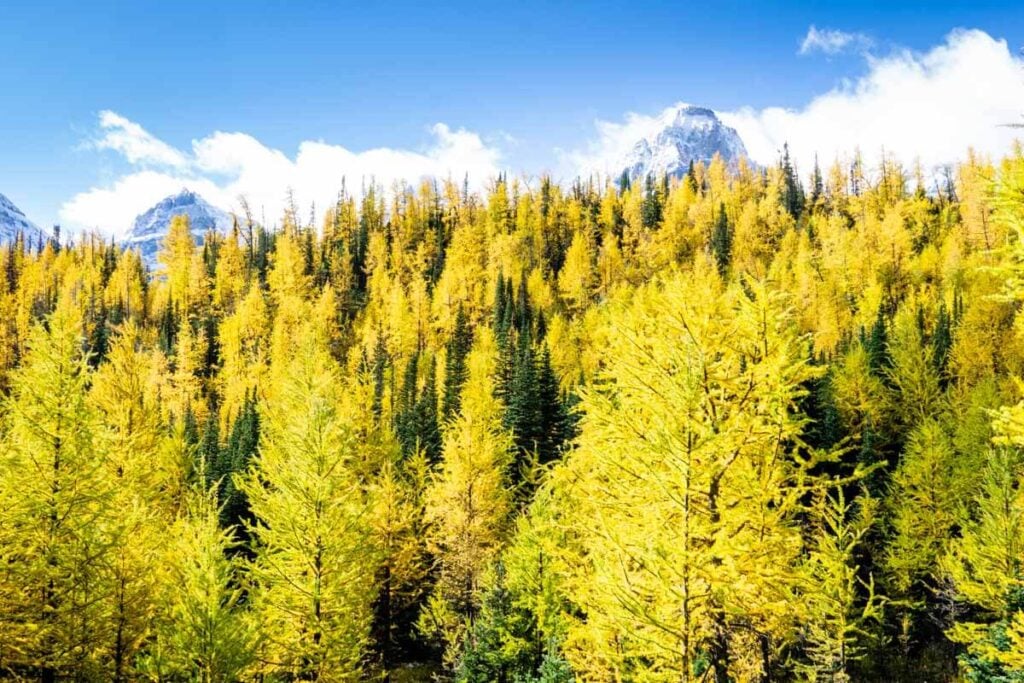
It’s the most popular larch hike in Alberta for good reason. It begins with a series of challenging switchbacks, but once the Larch Valley trail levels off and you enter the golden larch forest, you’ll understand why people flock here every peak larch season. It’s one of the very best hikes in Banff and is nothing short of spectacular.

While the Larch Valley hike takes you through an impressive larch forest, we recommend continuing past to the Minnestimma Lakes where you can enjoy the incredible fall scenery from a different vantage point. Then, if you have the time and energy, continue on to hike Sentinel Pass for stunning views over Larch Valley with the Ten Peaks looming in the distance.

Due to the popularity of the Larch Valley hike, your biggest challenge will be getting to Moraine Lake. To help you, we’ve written a full post on how to get to Moraine Lake to enjoy the Larch Valley hike.

Read More
If you’d like more information on this iconic larch tree hike near Calgary, we have a full post on the Larch Valley hike in Banff National Park.
Eiffel Lake Larch Hike
If you can’t get enough of those golden larches while at Moraine Lake, then leave time to visit Eiffel Lake. Eiffel Lake is another of the best Moraine Lake hikes that leaves from the shores of this iconic mountain lake.
Eiffel Lake Hike Stats
Distance: 12.2 km / 7.6 miles out-and-back
Elevation Gain: 610 m / 2,001 ft
Difficulty: Moderate
Time Required: 3-4 hours round-trip

Starting at the same trailhead as Larch Valley and Sentinel Pass, you’ll follow the switchbacks up to a junction with a bench (don’t worry, you won’t miss it). From there, you’ll leave the Larch Valley Trail and begin the Eiffel Lake hiking trail.
Like many other larch hikes near Calgary, it’s hard to compete with Larch Valley. Don’t let that scare you, where Eiffel Lake might lack in the density of larch trees, it makes up for it with stunning views of the Valley of Ten Peaks and fewer crowds.


You’ll still get your fill of larches along the hiking trail, and you’ll also get spectacular views of a large stand of larch trees from a distance!

Read More
If you’d like more information, we have a full post on the Eiffel Lake Larch Hike in Lake Louise.
Wenkchemna Pass Hike
One of our favourite larch hikes near Calgary is the Wenkchemna Pass Trail. An extension of the Eiffel Lake trail, it adds about 6 km to the hike for a total round-trip distance of 18.3 km from the trailhead.
WenkChemna Hike Stats
Distance: 18.3 km / 11.6 miles out-and-back
Elevation Gain: 929 m / 3,047 ft
Difficulty: Moderate to Difficult
Time Required: 4-6 hours round-trip

The larches get more sparse the further you go along the Wenkchemna Pass trail, and eventually you’ll find them to be much smaller in the alpine meadow.

However, the view from Wenkchemna Pass down over Eiffel Lake and its golden larch forest is pretty spectacular!
The Wenkchemna Pass Trail is fairly easy until the 500 m or so up to the pass, where it becomes steep and the path is more difficult to follow. You won’t be disappointed with the view over both sides of the pass!

Read More
We love this add-on hike! If you’d like more information, we have a full post on the Eiffel Lake to Wenkchemna Pass Hike in Lake Louise.
Best Larch Hikes at Lake Louise
If you are looking for the best larch hikes near Calgary, Lake Louise area is a great option. There are several stands of golden larches on the mountains surrounding Lake Louise, giving hikers many options to choose from.
Saddleback Pass Larch Hike
Saddleback Pass may not be the most famous larch hike in Alberta, but it is one of the best hikes in Lake Louise, and a particularly good alternative to Larch Valley.
Saddleback Hike Stats
Distance: 7.4 km / 4.6 miles out-and-back
Elevation Gain: 595 m / 1,952 ft
Difficulty: Moderate (note: Parks Canada rates this hike as ‘difficult’)
Time Required: 2-3 hours round-trip

The Saddleback Pass hike begins near the shoreline of Lake Louise (near the Fairmont Chateau Lake Louise), making it one of the most beautiful trailheads you’ll find anywhere in the world. You’ll hike uphill through a beautiful conifer forest for 2 km along the northern slopes of Fairview Mountain (2,744 m) before you encounter the first of the golden larches.
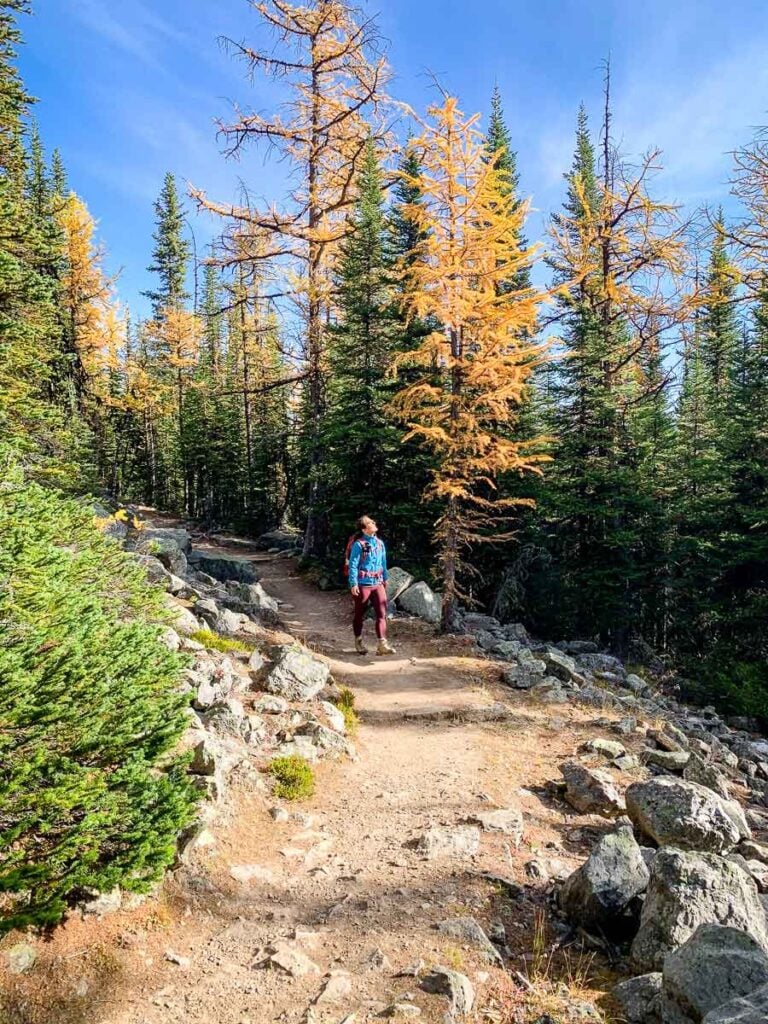
For the next 2 km, you’ll be awestruck as you walk through a beautiful forest of golden larches all the way to Saddleback Pass. The density of larches on this Lake Louise hike is very impressive and chances are good that you won’t put your camera down the entire 2 km!

Read More
If you’d like more information, we have a full post on the Saddleback Pass Larch Hike in Lake Louise.
Sheol Valley Larch Hike
As great as the Saddleback Pass hike is for larch tree viewing, the one knock on it is the crowds. Saddleback Pass is a very popular alternative to Larch Valley, making it difficult to get great images of larches with all the other hikers around.
Sheol Valley Hike Stats
Distance: 14.7 km / 9.1 miles round trip
Elevation Gain: 884 m / 2,900 ft
Difficulty: Moderate (it’s long, but not that difficult)
Time Required: 4-5 hours round-trip
The solution to your larch tree crowding problem is to keep on hiking! Once you reach Saddleback Pass, you don’t need to turn back… you can continue your hike beyond Saddleback Pass into the Sheol Valley to enjoy larch trees without the crowds.

Of course, nothing in life is free… you’ll enjoy lots of beautiful larch trees in the Sheol Valley without any crowds, but it will take you an additional 11 km to circumnavigate Saddle Mountain to get back to Chateau Lake Louise. The scenery along Sheol Valley is epic and it’s mostly downhill or flat hiking, so it’s not as bad as it may sound.


Read More
If you’d like more information on this secluded Lake Louise larch tree hike, we have a full post on the Sheol Valley to Paradise Valley Hike.
Big Beehive Hike
You won’t often see the Big Beehive hike at Lake Louise listed under the best larch hikes near Calgary because it doesn’t have the same density of larch trees as the more popular hikes like Pocaterra or Larch Valley. That being said, you’ll still get to experience the incredible glow of the golden larch trees on this hike, along with some spectacular views of Lake Louise.
Big Beehive Hike Stats
Distance: 11.4 km / 7.1 miles loop
Elevation Gain: 520 m / 1,706 ft
Difficulty: Moderate
Time Required: 3-4 hours round-trip

Not only is there a large stand of them at the Big Beehive Lookout, but you’ll find larch trees at the end of Lake Agnes and along the switchbacks to the top of the Big Beehive.
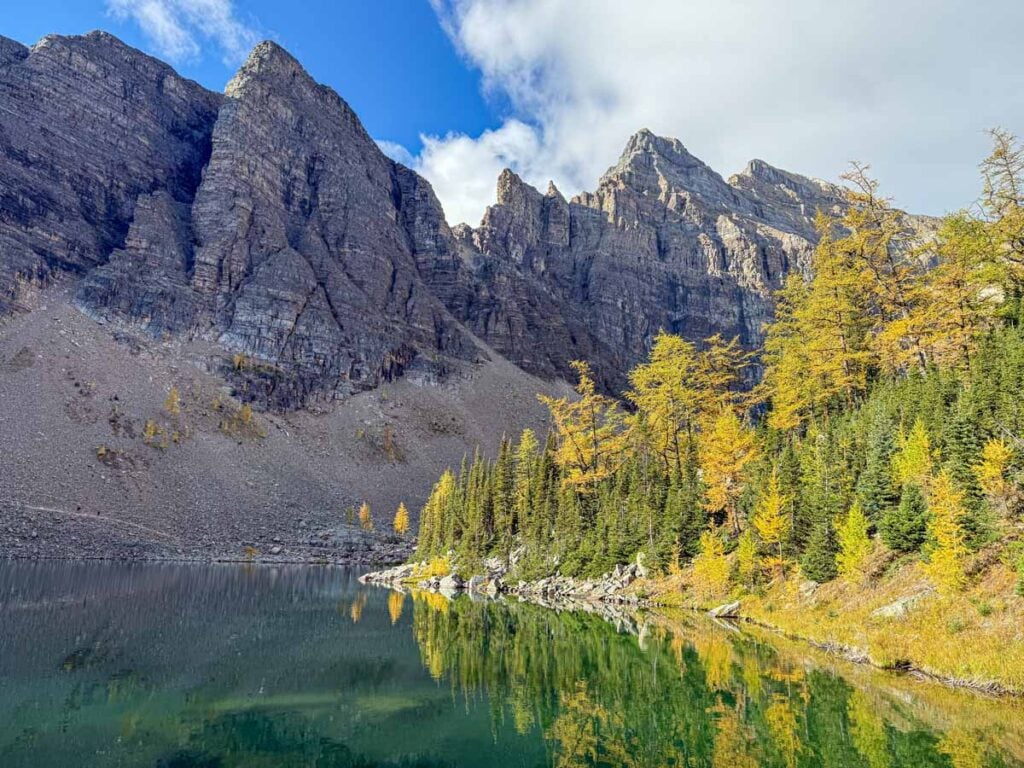

We hiked the Big Beehive trail in mid-October one year, well past peak larch season in Banff, but knew we had to add it to our list of larch hikes near Calgary. We returned the following year in September and timed it almost perfectly. The larches along Lake Agnes were still a bit green, but they were golden and glowing at the top of the Big Beehive.


Read More
If you’d like more information on this popular Lake Louise larch tree hike, we have a full post on the Big Beehive Hiking Trail.
Hidden Lake Hike
The best Banff larch hikes can quickly become overrun with crowds when the larch trees are at their peak. If you are looking for a hike to see larch trees without the crowds, the Hidden Lake trail (in the Skoki area) is a great option.
Hidden Lake Hike Stats
Distance: 18 km / 11.2 miles out-and-back (includes 8 km along fire road)
Elevation Gain: 670 m / 2,198 ft
Difficulty: Moderate
Time Required: 5-6 hours round-trip

The Hidden Lake hike leaves from the Fish Creek parking area off Whitehorn Road near the Lake Louise Ski Resort. Unfortunately, the first 4 km of the Hidden Lake hike is along a service road (as with all the hikes in the Skoki area), which isn’t that exciting to walk. We were fortunate to join a Parks Canada guided hike to Hidden Lake, which included a shuttle bus which skips this first section.

The full Hidden Lake hike is 5.2 km each way and is a fairly easy hike. You’ll get to enjoy larch trees hugging the shores of Hidden Lake plus a great view of the larch trees throughout the Skoki Valley.
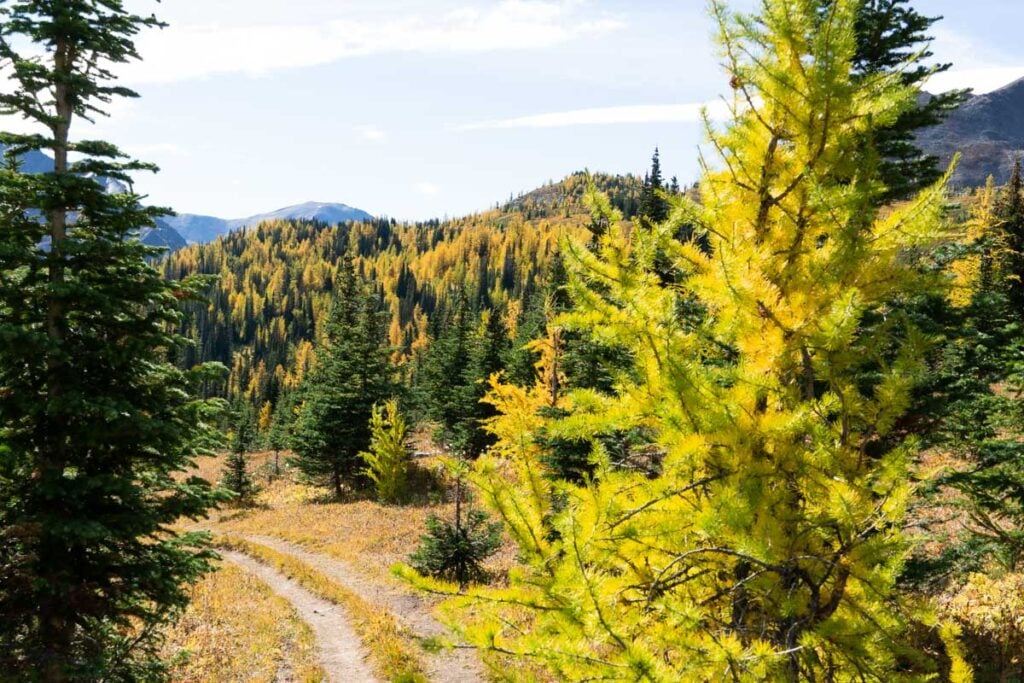

While there are other incredible hikes in the Skoki area for larch trees, the Hidden Lake Trail is the easiest and most doable.
Read More
Escape the crowds associated with larch-madness with the Hidden Lake Hiking Trail.
Pika Trail at Lake Louise Ski Resort
Unfortunately for non-hikers, the majority of the Banff larch hikes require hiking to elevations where the larches grow. While Larch Valley is the easiest among them, you can also see larches from two short hikes at the Lake Louise Summer Gondola: Pika Trail (with an extension to the Ptarmigan Valley Viewpoint) or the Kicking Horse Pass Viewpoint.
Pika Trail Hike Stats
Distance: 2.5 km / 1.6 miles out-and-back (3.4 km / 2.1 miles to Ptarmigan Valley Viewpoint out-and-back)
Elevation Gain: 200 m / 656 ft (341 m / 1119 ft to Ptarmigan Valley Viewpoint)
Difficulty: Easy
Time Required: 1-2 hours round-trip
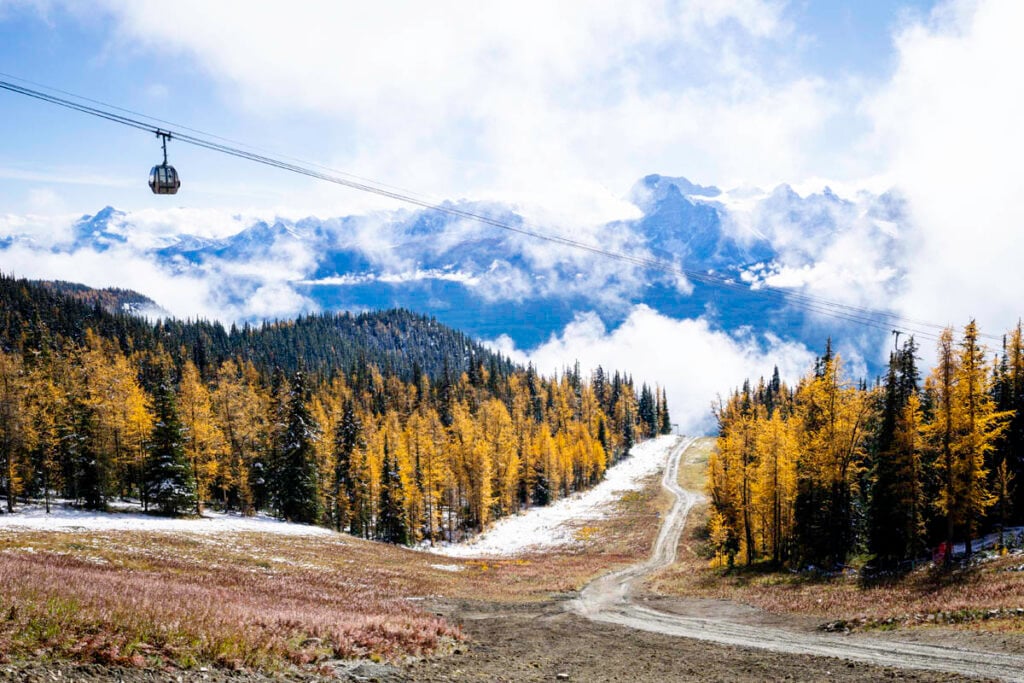
At the top of the Lake Louise Gondola, you’ll exit the protected fenced area to hike along the ski trails. The Pika Trail is the best Lake Louise Gondola trail to see larch trees, but I recommend continuing all the way to the Ptarmigan Valley Viewpoint. The Pika Trail will take you right through the larch forest.
If you continue on to the Ptarmigan Valley Viewpoint, you’ll get to see the larch forest you just walked through from above. You’ll also get to see the larches all down the other side of the valley. It’s well worth it to go to the top.
Kicking Horse Pass Trail at Lake Louise Ski Resort
Also found outside the fenced area, you can hike the Kicking Horse Pass Trail at the top of the Lake Louise Gondola. This is the shortest hike on our list of larch hikes near Calgary.
Kicking Horse Pass Hike Stats
Distance: 1.7 km / 1 mile out-and-back
Elevation Gain: 100 m / 328 ft
Difficulty: Easy
Time Required: 1-2 hours round-trip
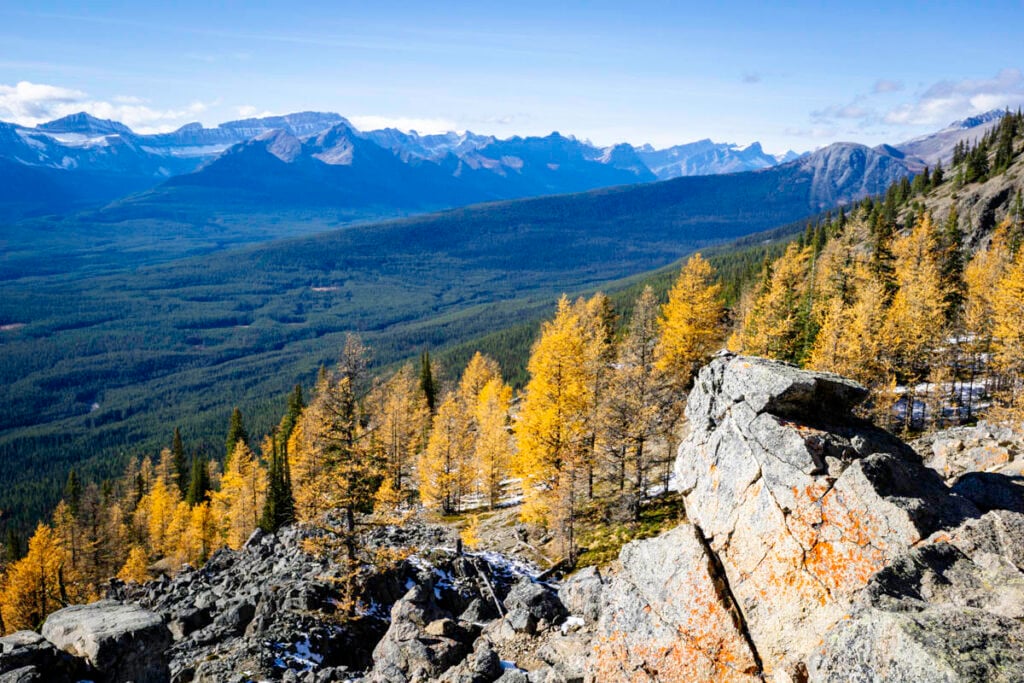
As it starts on the ski run (going uphill), it will be enough to get you breathing hard but it doesn’t last that long. Eventually, it will level off and you’ll make a turn into the trees. This trail will end at a large set of boulders surrounded by larch trees and some stunning views!
Lake Louise may be home to all the mega-popular larch tree hikes in Banff, but it doesn’t have a complete monopoly on them. There are several other excellent larch tree hikes outside of the Lake Louise area to see golden larches in Banff National Park.

Best Larch Hikes in Banff Outside Lake Louise and Moraine Lake
While Lake Louise and Moraine Lake are home to some of the very best larch hikes in Alberta, they do not have exclusive rights to these beautiful trees. You can find many other beautiful larch hikes elsewhere in Banff National Park. In fact, several of our favourite larch hikes near Calgary are within this section.
Healy Pass Larch Hike
If there’s a Banff larch hike to compete with Larch Valley, then it’s Healy Pass. The Healy Pass Trail has quickly become one of our favourite larch hikes and we hike it nearly every larch season.
Healy Pass Hike Stats
Distance: 18.3 km / 11.4 miles out-and-back
Elevation Gain: 890 m / 2,920 ft
Difficulty: Moderate
Time Required: 5-7 hours round-trip
The trail to Healy Pass starts out with a 7 km hike though a non-larch forest. While you’ll see many reviews complaining about this section being boring, we encourage you to enjoy the fall colours throughout this section even if they aren’t the sought-after larches.

This hike, while long, is really not that difficult. It has a very gradual incline the entire way, but as long as you can manage the distance you shouldn’t have any issues with this incredible larch hike in Banff.

Around the 8.5 km mark you will enter the meadow where you’ll be surrounded by larch trees.
Not only do you spend a remarkable amount of time in this very large larch forest, but you also get epic views of larches down through the valley as you continue up to Healy Pass. The larches in the alpine meadow become smaller and more spread out, affording hikers this incredible view.

Once at Healy Pass, the larch trees don’t stop! You’ll see them all down the slope on the other side towards Egypt Lake. This is the perfect place to stop for lunch and take in the views!

As an added bonus, the first part of the hike back down has beautiful mountain vistas glowing with golden larches.
Another huge benefit of the Healy Pass hike is that it leaves from the Sunshine Village parking lot, so there’s no concern about getting there early enough to find parking.
Read More
Find out more about why we think the Healy Pass Hiking Trail competes with Larch Valley as the best larch hike in Alberta.
Taylor Lake Larch Hike
Not much beats the sight of a larch forest in the fall, but if one thing could, it’s the sight of golden larches reflecting on the still water of a mountain lake high up in the Rocky Mountains.
Taylor Lake Hike Stats
Distance: 16 km / 10 miles out-and-back (including hike to meadow)
Elevation Gain: 1,035 m / 3,396 ft
Difficulty: Moderate (it’s long, but not that difficult)
Time Required: 4-5 hours round-trip
The hike to Taylor Lake is a very enjoyable walk through a lush non-larch evergreen forest. Aside from the occasional mountain stream, there’s not much in the way of scenery along the way to Taylor Lake, but it’s a beautiful forest and the payoff at the end is excellent.
Taylor Lake rests in a beautiful mountain cirque nestled in-between Mount Bell (2,910 m) and Panorama Peak (2,872 m). With towering Rocky Mountains overhead, Taylor Lake is beautiful year-round, but it’s especially striking during larch season when the larch trees along its shores turn golden yellow. If you hike to Taylor Lake on a calm day, the reflections of the larch trees in the water are incredible.

But wait… it just gets better! Walk to the back of the Taylor Lake Campground and you’ll find a sign for the Panorama Ridge hike. This short hike extension may be steep in spots, but it pays off big time. Before long, you’ll enter a huge forest of golden larches complete with a charming mountain stream running through. Don’t miss this short extension; it’s one of of our favourite larch hikes in Alberta.


Read More
Even without larches, find out why the Taylor Lake Trail is one of our favorite hikes in Banff.
O’Brien Lake Hike
If you’d like more hiking, you can also hike to O’Brien Lake, which starts from the same trailhead as Taylor Lake and veers off at the junction in the meadow (there’s a sign you can’t miss). The Lake O’Brien hike is similar to the Taylor Lake hike and can offer equally beautiful larch tree reflections in the lake. It’s also lesser known so you’ll find more solitude at O’Brien Lake.
O’Brien Lake Hike Stats
Distance: 18.8 km / 11.7 miles out-and-back
Elevation Gain: 1,155 m / 3,789 ft
Difficulty: Moderate
Time Required: 4-5 hours round-trip

Read More
Learn more about the add-on hike from Taylor Lake to O’Brien Lake.
Arnica Lake Hike
The hike to Arnica Lake gives hikers not one, but two Banff lakes to stop at along their journey. Starting from the Vista Lake parking lot, the Arnica Lake hike begins with a descent down to the beautiful Vista Lake. With the emerald green Vista Lake sparkling in the sunlight and the golden larches on the shoulder of Storm Mountain, this is one beautiful fall hike in Banff!
Arnica Lake Hike Stats
Distance: 9.3 km / 5.8 miles out-and-back
Elevation Gain: 758 m / 2,487 ft
Difficulty: Moderate
Time Required: 3-4 hours round-trip
While the trail starts as a descent and is well groomed until you reach the shores of Vista Lake, it quickly changes. From Vista Lake the Arnica Lake trail begins to climb. With plenty of roots and rocks to trip you up, it gets to be a much harder hike.

While the trail gets more challenging, the views get better and better as you look over the Bow Valley. You also get closer to the glowing golden larches on Storm Mountain.

This view alone would be enough to recommend the Arnica Lake trail as a larch hike, but there are two more spots on this hike to enjoy the golden larch trees while hiking in Banff in fall. The next spot for fall colours along the trail is the beautiful Arnica Lake with the far shores surrounded with larch trees at the base of Storm Mountain.

The second is past Arnica Lake on the hiking trail to the Twin Lakes. Even if you just climb to the top of the meadow, you’ll find yourself surrounded by larches with views of more in the distance. While this larch forest may not be as dense as the one you walk through at Larch Valley, it’s well worth the effort!

Read More
We have a lot more beautiful pictures and information in our complete blog post about the Arnica Lake Hike.
Need Help with Your Banff Itinerary?
Get our 4 Day Banff Larch Hiking Itinerary. In this mobile friendly itinerary, we share our favourite larch hikes in the area, PLUS everything else you need to plan your trip.
Best Larch Hikes in Kananaskis Country
Kananaskis also has some incredible larch hikes. Aside from the larch hikes at the Lake Louise Ski Resort, this is where you’ll find the best kid-friendly, easy larch hikes near Calgary.
Note that vehicles parked at provincial park and public-land sites in Kananaskis Country and the Bow Valley need a Kananaskis Conservation Pass.
Burstall Pass Larch Hike
Burstall Pass is considered by many to be the best larch hike in Kananaskis Country. It’s one of the hardest larch hikes in this post, but you’ll be rewarded with a walk through and eventually above a large larch forest.
Burstall Pass Hike Stats
Distance: 16.4 km / 10.2 miles out-and-back
Elevation Gain: 667 m / 2,188 ft
Difficulty: Moderate to Difficult
Time Required: 4-5 hours round-trip
The first 4.5 km of the Burstall Pass trail is actually quite easy. Your hike starts with some excellent scenery, as you pass the Hogarth Lakes. Soon, the hiking trail enters a valley between Mount Burstall (2,760 m) and Commonwealth Peak (2,774 m).
The trail climbs slowly and eventually passes a series of beautiful lakes created by Burstall Creek. The reflections of the surrounding Rocky Mountain peaks glimmering in the water are amazing. Don’t forget to look up as you’ll start getting glimpses of larch trees ahead.
Beyond the lakes, you’ll enter a large, open meadow, where a series of mountain streams converge. The meadow is filled with small shrubs with golden yellow leaves. They aren’t larches, but the cumulative effect of all these golden bushes is pretty impressive.

Beyond this meadow, the trail gets much steeper and you’ll start to get your sweat on. You’ll be rewarded for your efforts with a walk through a large forest of golden larches.

They keep getting better and better the higher you go. Eventually you climb above the treeline, where you’ll enjoy sweeping views of jagged Rocky Mountains and the larches below. It’s one of the nicest vistas of Kananaskis larch trees you’ll find anywhere!

Read More
We have all the information you need to enjoy this amazing Kananaskis larch hike in our full blog post on the Burstall Pass Trail.
Pocaterra Ridge Larch Hike
If Burstall Pass has a rival for the best larch hike in Kananaskis, it’ll be the Pocaterra Ridge hike. Located near the Highwood Pass (Canada’s highest paved road), the Pocaterra Ridge Trail is an outstanding hike through a very large larch tree forest surrounded by jagged rocky peaks in all directions.
Pocaterra Ridge Hike Stats
Distance: 6 km / 3.7 miles to end of larch forest. 8.4 km / 5.2 miles to the summit
Elevation Gain: 659 m / 2,162 ft to summit (300 m / 984 ft to end of larch forest)
Difficulty: Moderate
Time Required: 3-4 hours round-trip

It takes less than a kilometer of hiking to see the first stand of larch trees on Mount Pocaterra. As exciting as this sight will be, don’t linger for long as the Pocaterra Ridge larch trees get much better further down the trail.
The setting for the Pocaterra Cirque trail is jaw-droppingly beautiful. This moderate Kananaskis larch hike leads hikers into a mountain amphitheatre where the towering peaks of Highwood Ridge, Mt. Tyrwhitt and Mount Pocaterra wrap around you on all sides.
From the first larch tree to the last, the larch forest on this popular Kananaskis hike extends nearly 2 km, making it one of the most extensive stands of larch trees in Alberta.

As if this hike wasn’t already good enough, you have the chance to hike beyond the larch trees to the summit of Pocaterra Ridge. From this perch, you’ll enjoy one of the best Kananaskis mountain vistas you will find anywhere. From up top, it’s a 360-degree view which extends as far north as Mt. Kidd!

Read More
If you’d like more information, we have a full post on the Pocaterra Ridge larch hike in Kananaskis Country.
Ptarmigan Cirque Larch Hike
Ptarmigan Cirque is one of the best kid-friendly, easy hikes in Kananaskis Country near the Highwood Pass. The Ptarmigan Cirque hike is a great option for the whole family and for people who want an easy larch hikes near Calgary.
Ptarmigan Cirque Hike Stats
Distance: 3.6 km / 2.2 miles loop
Elevation Gain: 267 m / 875 ft
Difficulty: Easy
Time Required: 1-2 hours round-trip
This easy Kananaskis larch hike begins at 2,184 m above sea level, the perfect altitude for Subalpine larches to grow. Accordingly, it doesn’t take much effort to start seeing larch trees. After carefully crossing Highway 40, the Ptarmigan Cirque larch hike enters a 1.3 km hike through an evergreen forest.

A large forest of larch trees hugs the line where the forest meets the alpine layer of the mountain. The Ptarmigan Cirque hiking trail leads you through these golden larches, allowing an up-close experience. As a bonus, you’ll be able to see large stands of larches across the highway on Highwood Ridge.

There is more to the Ptarmigan Cirque hike than larch trees; the section of trail which winds through the rocky, treeless cirque is very beautiful. The slopes of Mount Rae (3,218 m) and Mount Arethusa (2,912 m) wrap around you to create an intimate, rocky amphitheater.
Read More
If you’d like more information, we have a full post on the Ptarmigan Cirque hike in Kananaskis Country.
Arethusa Cirque Larch Hike
One minute down the road from Ptarmigan Cirque, Arethusa Cirque is another kid-friendly larch hike in Kananaskis Country near the Highwood Pass. Arethusa Cirque is less popular than Ptarmigan Cirque, likely because a few short, but very steep sections may prevent some from enjoying this Kananaskis larch hike.
Arethusa Cirque Hike Stats
Distance: 4.6 km / 2.9 miles loop
Elevation Gain: 337 m / 1,106 ft
Difficulty: Easy
Time Required: 1-2 hours round-trip
The Arethusa Cirque hike begins at 2,144 m, so it doesn’t take much time or effort to start seeing larch trees. After 0.5 km of hiking through a typical conifer forest, you’ll start encountering larch trees.

Shortly after, you’ll find yourself in a scenic open meadow, standing on the edge of a babbling brook surrounded by larches. The towering peaks of Storm Mountain (3,095 m), Mount Arethusa (2,912 m) and Little Arethusa (2,767 m) loom above in the background, completing the magical mountain scene.

From here, you’ll continue hiking along a 3.2 km loop. Going counter-clockwise, you’ll follow the babbling brook through the larch forest onto the lower slopes of Storm Mountain. A sharp left turn onto a short scree field takes you above the tree line, where you’ll marvel at the golden larches in the forest below.
The aerial views of the large larch forest continue as you leave the scree and transition to a beautiful grass meadow on the slopes of Mount Arethusa. This is a great spot to break for lunch and enjoy the views of the Kananaskis larch trees.
The descent back to the beginning of the loop is short, but very steep. Bring trekking poles if you need help with your knees or balance.

Read More
If you’d like more information, we have a full post on the Arethusa Cirque larch hike in Kananaskis Country.
Tent Ridge Horseshoe Larch Hike
Tent Ridge is one of the most scenic larch hikes in Kananaskis, but it is also one of the most difficult hikes on this list. This challenging loop along the Smith-Dorrien Highway rewards hikers with incredible views over Spray Lakes, Shark Lake, Tryst Lake and the surrounding Kananaskis peaks.
Tent Ridge Hike Stats
Distance: 10.5 km / 6.5 miles loop
Elevation Gain: 843 m / 2,765 ft
Difficulty: Difficult
Time Required: 5-6 hours round-trip
The larches on the Tent Ridge Horseshoe Trail are not the only reason to do this hike, but they are a beautiful bonus in fall. You’ll hike through sections of larch forest early in the route, but the real payoff comes once you gain elevation and can look down over the golden larches spread across the slopes below.
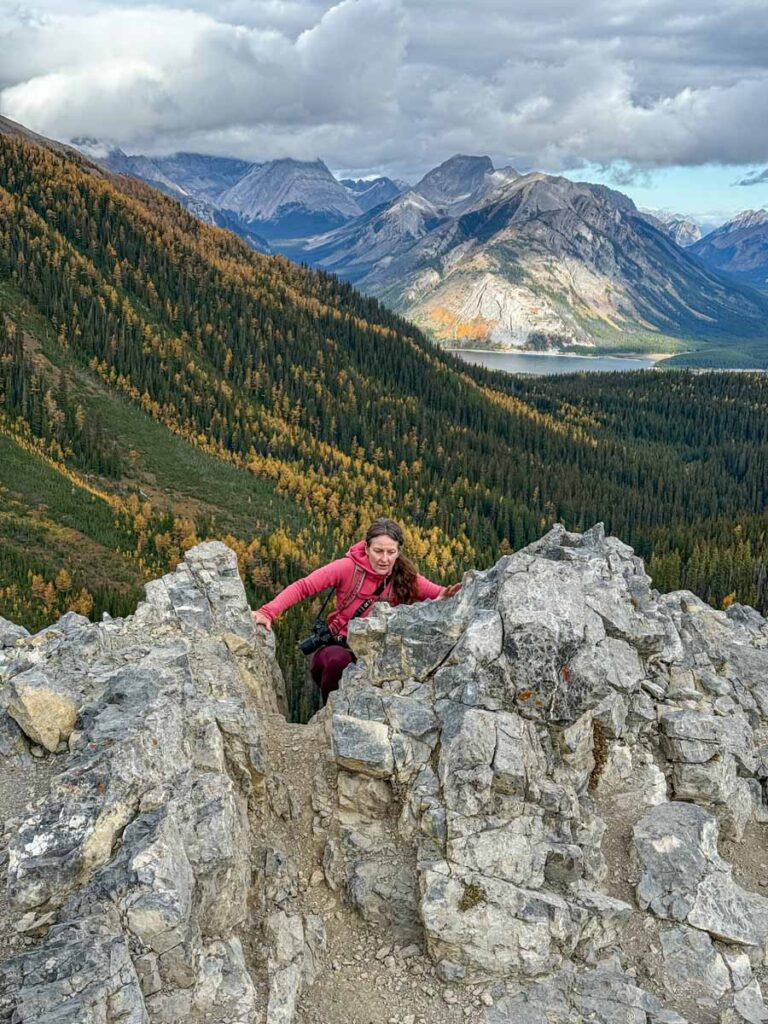
This is not a casual larch hike. Tent Ridge has extended steep climbs, loose gravel and shale, short scramble sections and exposed ridge terrain with serious drop-offs. It’s best for experienced hikers who are comfortable with exposure and loose mountain terrain, especially during larch season when early snow or ice can make the ridge much more dangerous.
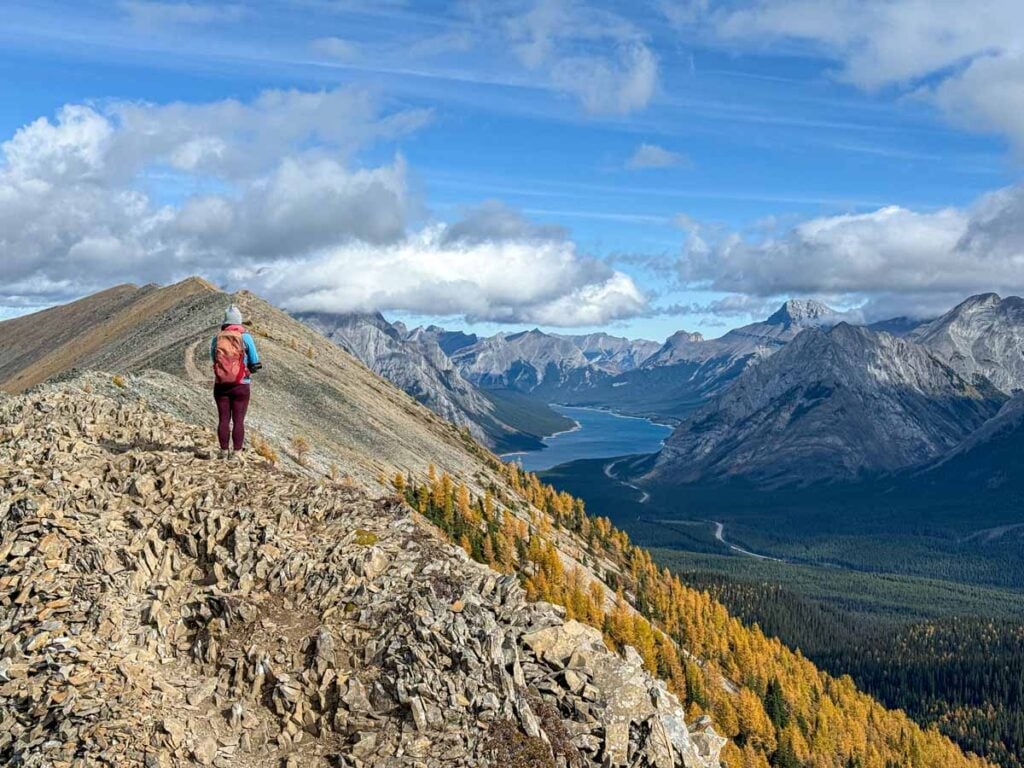
If you have the right hiking experience, Tent Ridge is well worth the effort. The ridge views are outstanding, and in late September the golden larches add even more colour to an already dramatic Kananaskis hike. For a safer larch hike in this area, Chester Lake or Rummel Lake are better options.
Read More
If you’d like more information, we have a full post on the Tent Ridge Trail in Kananaskis Country.
Chester Lake Hike
Chester Lake is one of the best hikes in Kananaskis Country. In fact, it’s our favourite all-season hiking / snowshoeing trail in Kananaskis Country. Just 3 km of hard work up the lower slopes of Mount Chester (3,054 m) pays off with an easy 2 km walk through a grassy alpine meadow, complete with a beautiful stream and jagged mountain peaks all around.
Chester Lake Hike Stats
Distance: 9.0 km / 5.6 miles out-and-back
Elevation Gain: 433 m / 1,421 ft
Difficulty: Moderate
Time Required: 2.5-3 hours round-trip

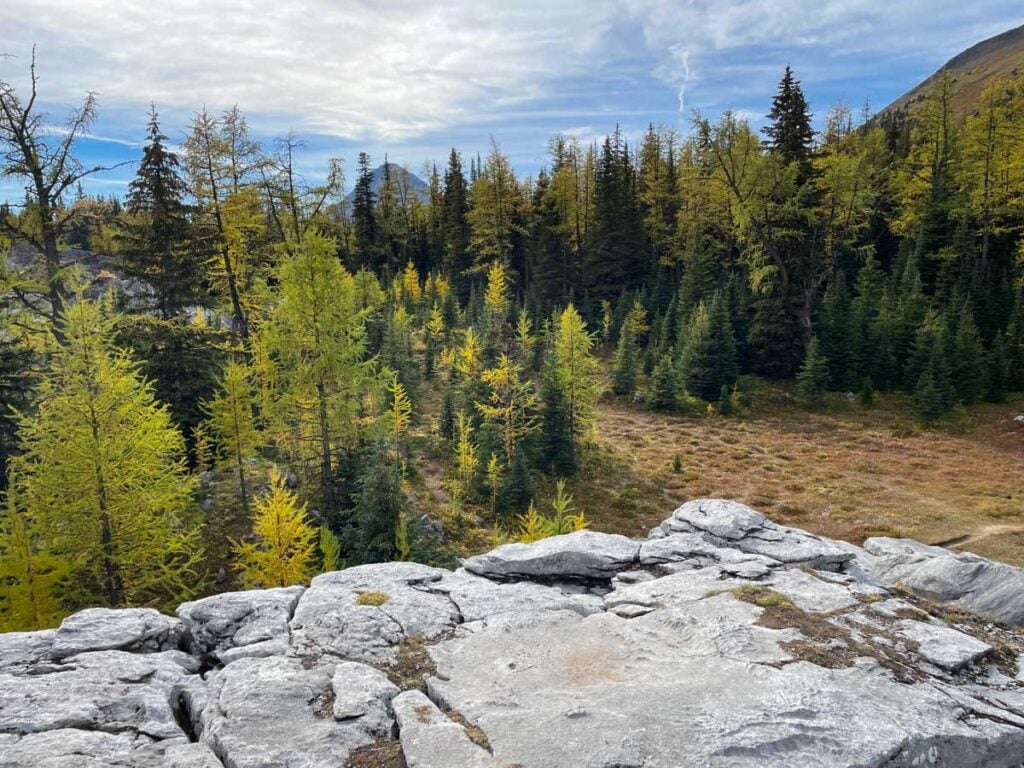
It’s easy to see why Chester Lake is one of the most popular hikes in Kananaskis. The Chester Lake hike shows up on most lists of the bets larch hikes near Calgary. You’ll pass through a few larches on the way to the lake, and there’s a few more along the shores of Chester Lake.

If you continue another 0.5 km past Chester Lake to the Elephant Rocks, you’ll find a bigger patch of larch trees, but it’s still pretty modest compared to some of the amazing Alberta larch hikes listed above.

Read More
You’ll never regret a hike to Chester Lake, but don’t do it just for larch trees. If you’d like more information on this rewarding Kananaskis hiking trail, we have a full post on hiking Chester Lake Trail.
Rummel Lake Larch Hike
Rummel Lake has been one of our family’s favourite all-season hikes for years. Located just north of the Burstall Pass larch hike in the Spray Valley Provincial Park, Rummel Lake offers hikers a chance to see bright-yellow larch trees in a beautiful mountain lake setting.
Rummel Lake Hike Stats
Distance: 11.7 km / 7.3 miles out-and-back
Elevation Gain: 449 m / 1,473 ft
Difficulty: Moderate
Time Required: 2.5-3.5 hours round-trip
The first 2 km of the Rummel Lake larch hike is along a wide, well-groomed hiking trail with an easy incline slope. You’ll be surrounded by boring old evergreen trees, but the wide trail allows enough sunlight for a wide variety of bushes to grow. In the fall, these bushes will reward you with a surprising variety of fall colours, ranging from golden yellow to purple to red.

At the end of this section, you’ll enter an open meadow with excellent views of the Spray Lakes. You’ll see patches of larch trees on the upper slopes of the surrounding mountains.
Continuing on, you’ll cross over the High Rockies Trail and will re-enter the deep evergreen forest. The hiking trail is no longer groomed, and you’ll need to negotiate protruding tree roots the rest of the way to Rummel Lake. With proper hiking shoes, it won’t be an issue.
Our kids started singing “The forest that never ends” along this 3.5 km stretch of forest. Admittedly, there isn’t much to see besides trees, but if you keep your eyes open, you’ll start noticing larch trees off to the left. There are a lot of larches along the Rummel Lake Trail, but most of them are 25-50 feet off to the left of the trail.

After 6 km of hiking, you’ll leave the forest and arrive at Rummel Lake, resting at the foot of Mount Galatea (3,185 m). You’ll be rewarded with a ring of golden larches surrounding the shores of Rummel Lake.

Read More
If you’d like more information, we have a full post on the Rummel Lake larch hike in Kananaskis Country.
Larch Hikes in Yoho National Park
Although there are many excellent hiking trails in Yoho National Park, only Lake O’Hara has larch trees.
Lake O’Hara Hiking Trails
Lake O’Hara is truly an incredible place to visit and to hike. While it’s not in Alberta, the alpine lakes surrounded by larch trees make Lake O’Hara one of the best areas for seeing larches. Given its very close proximity to Banff National Park, we felt it should be included.
Located in Yoho National Park in British Columbia, the Lake O’Hara area is one of the hardest places to visit in the Canadian Rockies.

There are tightly controlled visitation limits for Lake O’Hara, meaning hikers must either be very lucky (winning the draw for a bus ticket) or very determined (hiking the 11 km access road one way). The exceptions are visitors staying at the lodge or camping in the area. See our guide on how to visit Lake O’Hara for more information.
While there are plenty of golden larch trees that would impress anyone, the true beauty of hiking at Lake O’Hara is getting to enjoy it without crowds.

There are enough hiking trails in the area that you’ll feel like you almost have it to yourself.
If you are only hiking one trail, the Lake Oesa trail will give you the best value as far as sights and larches.

We did most of the Alpine Circuit, but opted to skip the All Souls Prospect trail so we could spend more time in the larches along the Opabin trails. We also hiked up the Big Larches Trail from Mary Lake to Shaffer Lake, just to hike a little more amongst the golden larch trees.

Read More
There are so many amazing hikes around this beautiful, secluded spot in the Canadian Rockies. Find the best one for you in our complete guide to Lake O’Hara hiking.
Other Alberta Hikes with Some Larches
Many of the best larch hikes near Calgary listed above will suffer from jam-packed parking lots and crowded trails, especially if you go mid-day on a weekend. If you’d like to experience some excellent hikes, with fewer crowds, try some of these hikes instead. Each of them is an excellent hiking trail by its own merits, but also offers the chance to see a few larch trees as well.
Plain of Six Glaciers Hike
Lake Louise is blessed with some of the best larch hikes in Alberta, but the Plain of Six Glaciers hike is not one of them. Once we forgive the Plain of Six Glaciers for not having a dense larch forest, we can focus on the fact this is one of the very best hikes in Banff.
Plain of Six Glaciers Hike Stats
Distance: 14.6 km / 9.1 miles out-and-back
Elevation Gain: 558 m / 1,831 ft
Difficulty: Moderate
Time Required: 3.5-5 hours round-trip
It’s an incredibly scenic hike, home to the famous Plain of Six Glaciers Tea House. There is a modest patch of larch trees just beyond the Six Glaciers Teahouse.

Read More
If you’d like more information on this spectacular Lake Louise hike, we have a full post on the Plain of Six Glaciers Hike.
Little Beehive Hike
The Little Beehive Hike won’t be the top of any lists of Alberta larch hikes, but you’ll certainly find some along the trail. We’d head over to the nearby Big Beehive hike for more larch trees or add this to an epic hike by adding on the Plain of Six Glaciers hike too. The mountain scenery and views down on Lake Louise will more than make up for the sparse larch trees.
Little Beehive Hike Stats
Distance: 8.8 km / 5.5 miles out-and-back
Elevation Gain: 490 m / 1,608 ft
Difficulty: Moderate
Time Required: 3-4 hours round-trip

Read More
If you’d like more information on this scenic Lake Louise hike, we have a full post on the Little Beehive Hike.
Where to See Larches Without Hiking
If hiking is not your cup of tea, don’t worry, there are still a few options to see Alberta larch trees without hiking.
Highwood Pass Larches
The Kananaskis Trail Highway (AB-40) starts at the Trans-Canada Highway near the Stoney Nakoda Casino. From here, it’s a stunning 80 km drive south through Kananaskis Country to the Highwood Pass, the highest paved road in Canada.

Along the Highwood Pass, you won’t need to leave your car to enjoy seeing golden aspens and Subalpine larch trees in their natural environment. There aren’t many larch trees growing next to the highway in the Highwood Pass, but it’s the best opportunity you’ll get to see natural larch trees without hiking.
Canmore Larches
If you’re not fussed about seeing larch trees in their natural environment, you can see lots of human-planted larch trees growing throughout the Three Sisters Mountain Village in Canmore. The TSMV is filled with condo developments for locals and weekenders alike. Many of these developments have landscaped their gardens with larch trees.
With regular water and human love, these Canmore larch trees grow very large and healthy. If you can forgive them their non-natural beginnings and environment, they are stunning in fall!

Read More
If you are not into hiking, check out the many other fun things to do in Banff for non-hikers.
Tips for Hiking During Alberta Larch Season
1. Get There Early
Every fall, parking lots throughout the Alberta Rockies fill up early every morning with eager hikers wanting to see golden larches in all their glory. It does not matter what day of the week you go, parking lots for larch tree hikes near Calgary will fill up quickly. It’s important to start early, plus you’ll enjoy the trails before they get too crowded.

Getting to Moraine Lake During Larch Season
Moraine Lake can no longer be reached by private vehicle. There are several ways to get to Moraine Lake, but almost all involve booking a shuttle or a tour. We highly recommend you read our post on Getting to Moraine Lake, but if you are short on time this is a summary of the best options that will give you time to hike Larch Valley.
1. Stay at Moraine Lake – While expensive, staying at the Moraine Lake Lodge will give you all the time you want at this spectacular Banff lake.
2. Parks Canada Shuttle – Book a Parks Canada Lake Louise Shuttle. If you don’t have a car, you’ll still need to get yourself to the Lake Louise Park and Ride near the ski resort.
3. Roam Transit – Take Route 8X (with a reservable Super Pass) to Lake Louise and take the Parks Canada Lake Connector Shuttle from Lake Louise to Moraine Lake.
4. Moraine Lake Bus Company – The Moraine Lake Bus company offers shuttle rides that will get you to Moraine Lake for sunrise or later. Just choose a departure time that will allow enough time for your hike. You’ll need to get yourself to the Samson Mall or the Lake Louise Park and Ride to park, depending on your departure time.
5. Via Via Moraine – The Via Moraine Lake Shuttle Service is an excellent way to get from Banff or Canmore to either Lake Louise or Moraine Lake. Their daytime shuttle will give you enough time to get a good hike in.
6. Fairview Limo – Fairview Limo provides transportation from the village of Lake Louise to Moraine Lake. Choose a return time late enough to allow you to hike. You still need to get yourself to the village of Lake Louise.
7. Guided Hike – Discover Banff Tours has a guided hike option for Larch Valley.
8. Hop On Banff – The Hop On Banff bus leaves from Banff and you can choose departure and return times that will allow you to hike at either Moraine Lake or Lake Louise.
9. Moraine Lake Big Bus – Moraine Lake Big Bus leaves from the Deer Lodge (a 5 minute walk to Lake Louise) and you can choose a return time late enough that you can fit in a hike. If you’d like a 5% discount on this shuttle bus (and many other Banff tour and attractions), visit our Banff discounts page for details.
For all other larch hikes near Calgary, we recommend arriving at the parking lot before 9 AM if possible, especially on weekends.
2. Use Shuttles or Roam Transit
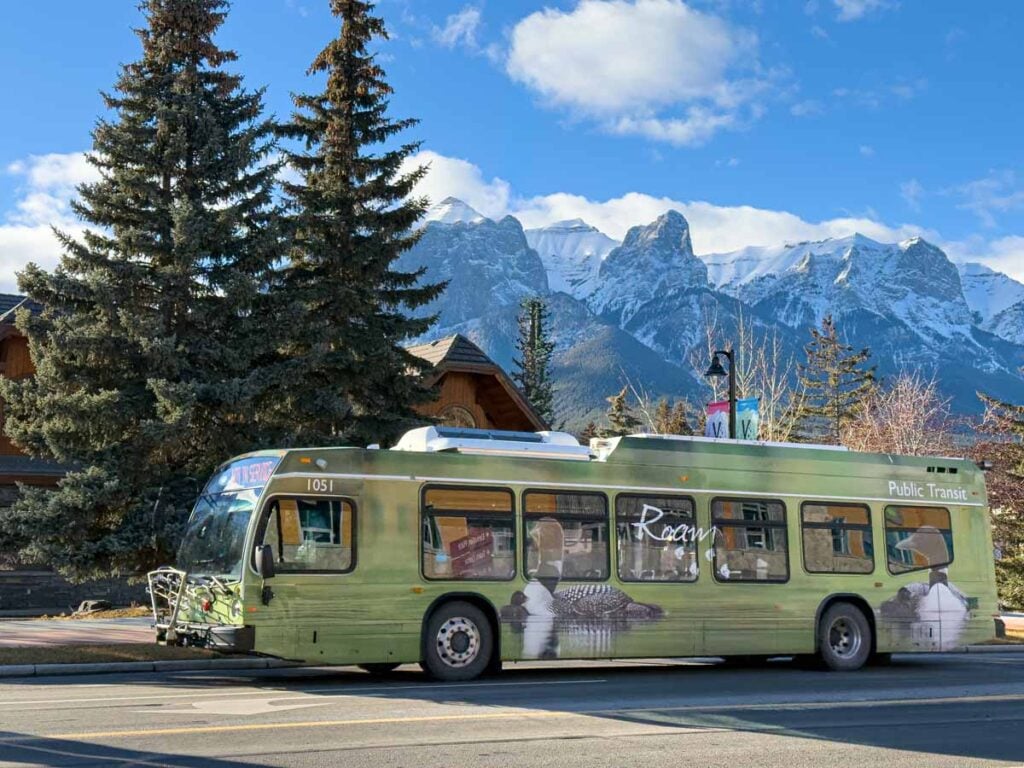
Many of these larch hikes near Calgary are some of the best hikes in Banff without a car. To get around the crazy parking situation, Parks Canada runs a shuttle service to Moraine Lake and Lake Louise during larch season every fall.
Note that reservations are required for the Lake Louise shuttle and the Moraine Lake shuttle. Only one shuttle ticket is required, as you can hop on the Lake Connector shuttle (included in your reservation) to get from Lake Louise to Moraine Lake and vice versa.
Alternately, you could take a Roam public bus from Banff to Lake Louise.
Choosing between the Parks Canada and Roam buses can be confusing. We help clarify things in our post on Parks Canada vs Roam Transit.
3. Stay Close to the Trailhead
A fun and easy way to enjoy golden larches without the super-early wake-up call is to eliminate the long drive and stay at a hotel close to the larch trees. See below for the best places to stay for larch trees.
4. Dress for Changing Fall Weather
Dressing for a day of hiking in the Alberta Rockies can be tricky, even in the heart of summer. Given peak larch tree season is typically between mid-September and early October, dressing appropriately is even harder. You’ll definitely want to pack layers.
Chances are that you will be starting your day early enough to get a parking spot. The sun is lower in the sky this time of year and will often be hiding behind mountain peaks. You may not get direct sunshine until mid-morning (if at all). No sunshine equals significantly colder temperatures.

Also, keep in mind that the temperature drops as you go higher into the mountains. Given the high elevations where larch trees grow, temperatures on your larch hike will be several degrees colder than the forecasted temperature for Calgary, Banff or Canmore.
Even if the forecast is for 20°C+, bring a warm jacket, gloves and a toque. Trust us, you’ll be glad you did.

Read More
For more detailed information about hiking in Alberta in fall, check out our guide to properly dressing for hiking in Banff.
5. Bring the Right Hiking Gear
In addition to packing layers of warm clothing, make sure you have all the appropriate hiking gear with you. In fall, bears are in their final push to fatten up, so carry bear spray where it is immediately accessible and know how to use it. You may also need appropriate traction devices for your hiking boots if your larch hike recently received a snowfall.

Read More
Our post on essential Banff hiking gear has a specific section detailing our recommended fall hiking gear in Banff.
Where to Stay for Alberta Larch Hiking
Fall is one of the most beautiful times of the year to visit Banff National Park and Kananaskis Country. The valleys are filled with golden aspen groves, the upper alpine forest glows with golden larches and the mountain peaks start to get a beautiful coat of snow.
The fall larch season is a great time of year to treat yourself to a stay at one of Banff’s best hotels. Not only will you enjoy a visit to one of Canada’s most beautiful regions, you’ll get a healthy head start on those who are leaving from Calgary, Canmore or Banff.
Where to Stay for Larch Valley
If you are lucky enough to get a reservation during larch season, treat yourself to a stay at the Moraine Lake Lodge. Not only is this one of the most scenic hotels in the world, you’ll get a guaranteed Moraine Lake parking spot. You can wake up at your leisure as the Larch Valley trailhead is just steps away from the Lodge.

Where to Stay for Lake Louise Larch Hikes
Larch season is a special time at Lake Louise, so why not make it a special getaway and stay at the world-famous Chateau Lake Louise? When you are not enjoying the many Lake Louise larch hikes which depart at the doorstep of the Chateau, you can pamper yourself with renowned Fairmont luxury. Get all the details in our review of the Chateau Lake Louise.
If the Chateau Lake Louise is not for you, there’s a great selection of great Lake Louise hotels to choose from.

Where to Stay for Kananaskis Larch Hikes
One of the best things about Kananaskis Country is that it is less commercial than Banff National Park. There are very few places to stay in Kananaskis, but here are two great choices for your larch tree getaway:
The 4-star Kananaskis Mountain Lodge is in Kananaskis Village, home to the alpine skiing events for the 1988 Olympic winter games. The Kananaskis Mountain Lodge is a mere 35-minute drive to the excellent Highwood Pass larch hikes. After a day of hiking among golden larches, soothe your sore muscles at the Kananaskis Nordic Spa.

Mount Engadine Lodge is an excellent hotel near the Smith-Dorrien Kananaskis larch hikes. You’ll love the remote location of the Mount Engadine Lodge, but you’ll really love that the Burstall Pass trailhead is a mere 13 minutes away! Treat yourself to a sauna or massage apres-larches.

Wildlife Safety
When hiking in Banff National Park, you are responsible for your own safety. Before hitting the hiking trails, we highly recommend you read our Essential Banff Hiking Tips for information about bear safety, trail conditions, wildlife warnings and possible closures.
Alberta Larch Season FAQs
What Do Larch Trees Look Like?
In the summer Alberta larch trees are full of green needles, making them difficult for a casual observer to distinguish a larch tree from other conifer trees. Starting in mid-September, Alberta larch trees become much easier to identify as the needles on larch trees turn a beautiful golden colour, while the other boring conifers stay green.

How Do You Identify a Larch Tree?
The easiest way to identify a larch tree is to wait until fall and watch for their needles to change to their famous golden colour.
If you’d like to identify an Alberta larch tree when their needles are not golden, the easiest way is to look at their needles. Larch trees in Alberta have little nipple-like bases protruding from their branches. From each of these nipples, a subalpine larch tree will grow up to 40 needles.

When Is Larch Season in Alberta?
The needles on larch trees start to change colour every year in mid-September. When they first change, the larch trees look lime-green, but before long they are ablaze with a full body of bright golden needles. The Banff larch season typically starts around mid-September until early-October. The larch season in Kananaskis is similar timing.

A great way to monitor when the larches start changing colour in Alberta is to read recent reviews for the Larch Valley Trail on AllTrails. This will help you find the best time to see larches in Banff, Kananaskis and the surrounding area.

Banff App Pick: AllTrails
AllTrails is one of our most recommended apps for visiting Banff, and your trip is the perfect time to try AllTrails Plus. Start with the 7-day free trial to download maps, save hikes, and use premium features before heading into the mountains.
How Long Do Larches Stay Yellow?
The answer to this question varies every year, but larch trees typically start dropping their needles in early October. You can still enjoy Alberta larch hikes if you are visiting Banff in October, but the golden needles become more sparse as the month progresses.

Where Do Larch Trees Grow in Alberta?
Subalpine larch trees grow at elevations of 1,800 to 2,400 m above sea level (5,900 to 7,900 ft). This is significantly higher than the elevation of Banff (1,383 m), Canmore (1,309 m) and Calgary (1,045 m).
Where Are Larches in Lake Louise?
Lake Louise is one of the best spots in Alberta to see golden larches in fall. The elevation of Lake Louise is 1,600 m, with surrounding mountain peaks ranging in elevation from 2,500 m to 3,400 m. These are ideal conditions for the Subalpine larch tree to thrive.
The best stands of larch trees in Lake Louise can be found on hikes around Larch Valley, Saddleback Pass and the hikes around Lake Agnes.

Where Are Larches in Kananaskis?
There are two primary clusters of larch trees in Kananaskis Country:
Highwood Pass
Reaching an elevation of 2,203 m, the Highwood Pass is the highest paved road in Canada. Several of the best larch hikes in Kananaskis are within easy driving distance of Highwood Pass, such as Pocaterra Ridge, Ptarmigan Cirque and Arethusa Cirque.

Smith-Dorrien Highway
The other hot spot for larch trees in Kananaskis Country is along the Smith-Dorrien Highway (AB742). Burstall Pass is one of the best larch hikes in Kananaskis, but you can also enjoy larch viewing around Rummel Lake and Chester Lake.

Where Are Larches in Banff?
The best area to view larch trees in Banff is the Lake Louise / Moraine Lake area. But the popularity of viewing larch trees around Lake Louise means that getting a parking spot is often difficult.
Some good alternatives to Lake Louise larch tree hikes are Taylor Lake, Arnica Lake and Healy Pass.
See the complete list in our post on the best larch hikes in Banff.

Where is Larch Valley?
The extremely popular Larch Valley hike is located at Moraine Lake, near Lake Louise in Banff National Park.

What Species of Larch Trees Grow in Alberta?
There are three species of Larch trees in Alberta.
1. The most common larch tree you will see in the larch hikes listed above is the Subalpine larch tree (also known as Lyall’s larch). Its Latin name is Larix lyallii.
2. The Western Larch (Larix occidentalis) grows to 70 m, making it the tallest of the Alberta larch trees. The Western Larch can primarily be found in Waterton and the Crowsnest Pass.
3. The third species of Alberta larch tree is the Tamarack (also known as the Eastern Larch). It’s most common north of the Red Deer River.

Support Human Created Content

Hi, we’re Dan & Celine Brewer, locals from just outside Banff National Park. Every article, itinerary, and recommendation we share is rooted in our real experiences and love for this place. If you’ve found our content helpful, please consider supporting us:
- Make a small donation: Your support directly fuels our work and keeps our stories genuine.
- Purchase a guide or itinerary: Essential tools that help plan your trip and support local creators at the same time.
- Book lodging or tours through our affiliate links: You pay the same price, but we earn a small commission that helps us keep producing content.
Thank you for valuing authentic, human-created content. Your support allows us to help even more Banff travellers!
Love our content? Sharing our post is the easiest way to support us!

Celine Brewer, a local Canmore resident, is the co-owner of Travel Banff Canada. She has a passion for being out in the mountains any time of year. In the summer, you'll often find her hiking or mountain biking. In the winter, she enjoys cross-country skiing, snowshoeing and winter hiking the most.
As much as she loves the mountains, she also loves travel! When she's not playing outdoors at home, she's either traveling the world with her husband and two kids or working on their other two travel sites: Family Can Travel and Baby Can Travel.