Winter hiking in the Canadian Rockies can be incredible, but snow and ice can completely change the trails you may be used to hiking in summer. Having the right winter hiking traction devices can make a huge difference, whether you’re walking an icy trail, hiking on hard-packed snow or heading out after a fresh snowfall.
As Canmore locals, we spend a lot of time outdoors in Banff and Kananaskis throughout the winter. Over the years, we’ve tried several different winter traction devices, including Kahtoola MICROspikes, snowshoes and Yaktrax. They all have their place, but they are definitely not interchangeable.
For most of our winter hiking, we reach for Kahtoola MICROspikes. They provide excellent traction on icy and hard-packed trails without the bulk of snowshoes. Snowshoes are a better option when you’re breaking trail through deeper snow, while Yaktrax can be useful for easier winter walks and icy sidewalks.

The best traction device for hiking really depends on the conditions and the type of outing you have planned. In this guide, we’ll explain when we use MICROspikes, snowshoes and Yaktrax, where each performs best and which ones we pack most often for our own winter adventures.
If you’re visiting Banff in winter, traction is only one part of being prepared. Be sure to check out our Banff winter packing list for everything else we recommend bringing.

This post contains compensated links.
Planning a Winter Trip to Banff?
The Banff & Jasper Planning Hub includes our Banff Winter Travel Guide, with practical winter advice, activity ideas, seasonal tips, and local guidance to help you plan your trip without feeling overwhelmed.
Best Winter Traction Devices for Hiking in Banff
There are several types of winter traction devices that you should consider for your trip to Banff National Park. Which type of traction device you choose depends on what type of winter activities you plan to do in Banff.
Which winter traction device should you use?
- MICROspikes: Best for icy or hard-packed winter hiking trails.
- Snowshoes: Best when you’re breaking trail through fresh, deep snow.
- Yaktrax: Best for sidewalks, town walking and easy, flatter winter walks.
- Trekking poles: Add stability regardless of which traction device you use.
Read More
Winter is such an amazing time to visit Banff. Don’t miss our list of the best things to do in Banff in winter.
Kahtoola MICROspikes
Our top recommendation for the most useful winter traction devices for visits to Banff is Kahtoola MICROspikes. Take a look at the steel spikes on the bottom of the Kahtoola MICROspikes and you’ll see why we love these traction devices so much. They are essentially a scaled-down, recreational version of the crampons you’ll see used on mountain expeditions, designed to give hikers extra traction on icy and hard-packed snowy trails.

We’ve owned Kahtoola MICROspikes for many years and are very happy with their effectiveness and sturdy construction. We frequently use them in place of snowshoes while enjoying popular winter hikes around Banff. They allow us to hike up the slippery slopes of the winter trails with confidence due to the excellent traction they provide.
When to Use Kahtoola MICROspikes
Kahtoola MICROSpikes are our go-to winter traction device for most of our winter activities in Banff National Park. Due to their small size and better traction on icy terrain, we use them for almost all of our winter hiking.

They’re especially useful on popular winter trails when the snow is hard packed. In these conditions, snowshoes are unnecessary, making the much smaller and lighter MISCOspikes a great choice.
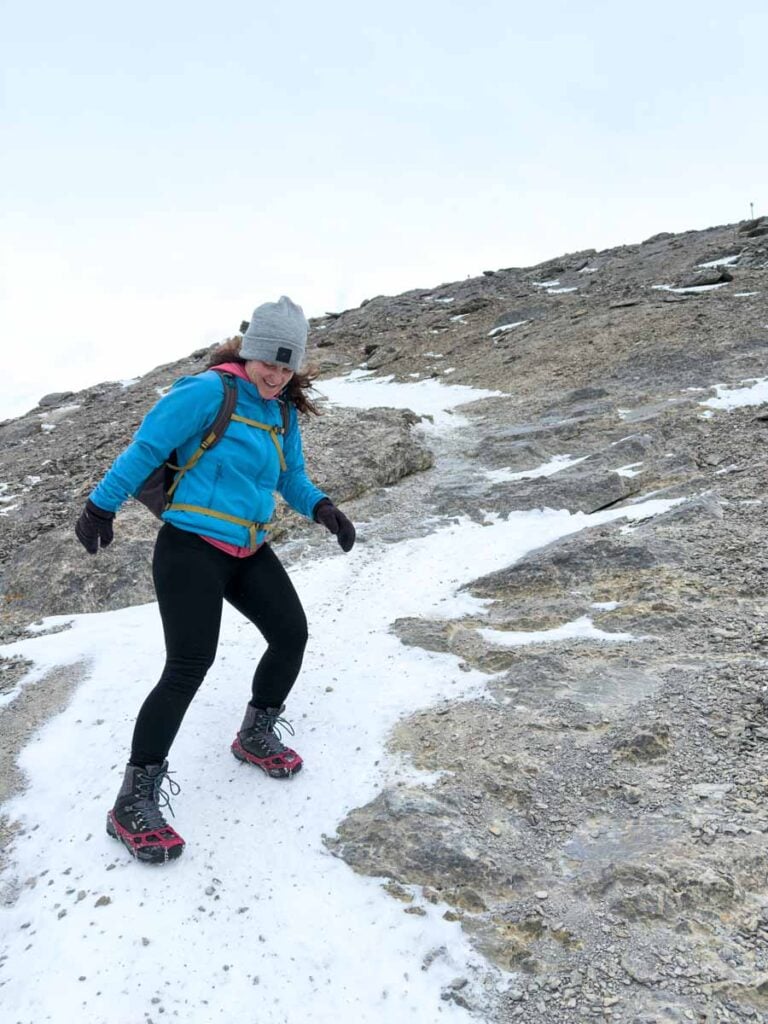
Another great use for Kahtoola MICROspikes is walking on sheer ice, such as when you are doing an ice walk. This is where we find Kahtoola MICROspikes especially useful. Of the traction devices we’ve tried, they give us the best grip on solid ice.

Read More
There is an ice walk not far outside Banff National Park which is the most fun you’ll ever have in your Kahtoola MICROspikes. Get all the information you need about the Grotto Canyon ice walk.
When Not to Use Kahtoola MICROspikes
There are two winter conditions in Banff National Park which make using Kahtoola MICROspikes less ideal.
If you’re heading out after a heavy overnight snowfall, then MISCROspikes are not your best choice. Breaking the trail in deep snow isn’t much fun in microspikes as your feet will go straight through the snow. In these conditions, snowshoes would be a better bet.

If you plan on spending most of your Banff winter vacation in the Town of Banff, then you likely won’t need a winter traction device as robust as the Kahtoola MICROspikes. If you’re walking on cleared pavement, such as sidewalks or streets, the larger spikes on the Kahtoola MICROspikes can be uncomfortable. For these in-town winter conditions, Yaktrax are a much better option.

Recommended Ice Walk Tour
Want to try an ice walk without buying your own traction devices? The Johnston Canyon Icewalk is another option. This enormously popular winter tour in Banff includes complimentary use of ice cleats and hiking poles.
Are Kahtoola MICROspikes Worth It?
If you are looking for good quality traction devices to use for a variety of winter activities around Banff and Kananaskis, we highly recommend Kahtoola MICROspikes. We wear them on almost all of our winter hikes in Banff National Park and neighboring Kananaskis Country.

Snowshoes
When we first started getting serious about winter recreation in Banff, we were all about snowshoeing. And for good reason: snowshoeing is a ton of fun! There are plenty of excellent snowshoe trails in Banff National Park and Kananaskis Country, which are so beautiful and rewarding in winter time.

After a while, though, we noticed that many of the popular snowshoe trails were already hard packed. Unless we hit a snowshoe trail right after a fresh snowfall, we realized that wearing snowshoes wasn’t really necessary and that MICROspikes are an easier choice.
When to Use Snowshoes
One very good reason to wear snowshoes in Banff is simply that they’re fun. If snowshoeing is an experience you want to have, there’s no reason to skip it just because another traction device might be more convenient.
If you head out after a heavy snowfall and are among the first people on the trail, snowshoes will be your best option by far. It will still be exhausting work being the first one to break the trail in deep snow, but snowshoes will make the job easier than MICROspikes.

When Not to Use Snowshoes
Snowshoes are also a poor choice for walking around the Town of Banff. They’re bulky, awkward on cleared sidewalks and simply unnecessary for getting around town. If conditions are icy, a lighter traction device such as Yaktrax are a much better option.
Don’t assume you need snowshoes simply because a route is described as a snowshoe trail. As popular winter trails can become hard packed between snowfalls, we suggest you check current trail conditions before choosing between ice cleats and snowshoes.

Are Snowshoes the Right Traction Device?
Snowshoeing in Banff is a lot of fun, makes for great photos and gives you that classic winter-in-the-Rockies experience. But, snowshoes are bigger, heavier and less versatile than MICROspikes, plus they are typically more expensive.
So, we recommend you wear snowshoes as your winter traction devices in Banff only if you want to for the experience.

If snowshoes are for you, make sure you have multiple crampons underneath your snowshoes with some on the front toe and a pair under your heel. Also, if possible, look for a pair of snowshoes with double-ratchet bindings and avoid snowshoes with any form of buckle bindings, as they tend to come undone, which gets annoying very quickly.
Yaktrax Traction Devices
If you’re planning more serious winter hiking or snowshoeing in Banff, then the two winter traction devices above are your best choices. However, if your winter vacation to Banff is more about enjoying the Town of Banff and perhaps some easy winter walks, then Yaktrax traction devices are a good option for you.
Yaktrax are a popular option for winter walking around Banff. Yaktrax uses steel coils rather than the larger spikes found on MICROspikes, making them more comfortable when walking on pathways and sidewalks, but less effective on uphill icy trails. They are perfect for walking about town in the middle of winter.
When to Use Yaktrax
As we’ve seen above, wearing MICROspikes and snowshoes on sidewalks in winter is not recommended. This is where Yaktrax are useful. The sidewalks in Banff are cleared frequently, but that doesn’t guarantee they won’t still be slippery. Yaktrax are perfect for walking around town and easy winter walks without much elevation gain.

When Not to Use Yaktrax
As mentioned above, the Grotto Canyon ice walk is one of my favorite things to do around Banff in winter. I recently went with a friend; I was wearing Kahtoola MICROspikes and he was wearing Yaktrax. I had to stop and wait several times as he couldn’t get up the steep, icy sections. The coils on the bottom of the Yaktrax just didn’t provide enough traction on the ice.

Yaktrax are not a good choice on ice walks or on winter hikes with a steeper incline. In these conditions, you will want winter traction devices with spikes, such as MICROspikes or snowshoes.
Different Types of Yaktrax
Yaktrax makes several different traction devices, and the three most relevant for winter walking and hiking are the Yaktrax Walk, Walk Plus and Pro. All three use steel coils underfoot rather than the larger spikes found on MICROspikes, but there are some important differences between them.
The Yaktrax Walk is the simplest option. It uses 1.2 mm steel coils and is designed mainly for walking on packed snow, slush and icy surfaces. Yaktrax lists it as best for things like walking around town or walking the dog, so this is the model I would look at for sidewalks and easy winter walks rather than more challenging trails.
The Yaktrax Walk Plus is similar, but it has a more durable thermoplastic upper that stays flexible in cold temperatures.
We own the Yaktrax Pro, which is the model we have personally used on winter trails. The Pro has slightly thicker steel coils and, most importantly, a removable strap that goes over the top of your boot to help keep the traction device securely in place.
For our purposes, I would think of them this way: Walk for town and easy winter walking, Walk Plus for a slightly more durable walking option, and Pro for more active use such as winter hiking. Even with the Pro, though, we still prefer MICROspikes when we know we’ll be hiking on steep or very icy trails.
Are Yaktrax Good for Winter Hiking?
We find Yaktrax by far the most comfortable option for walking around Banff. They work especially well on flat, hard surfaces such as sidewalks. They are perfect for traction on flat, hard surfaces like concrete, which may be slippery.
Trekking Poles for Winter Hiking
No matter which traction device you use for your feet, you should consider using trekking poles to help your balance. We’ve tried trekking poles and, to be honest, we don’t really like them. We rarely use them ourselves, although we seem to be in the minority. Trekking poles are widely used around Banff and Kananaskis in winter.
It makes sense as winter hiking on snow or ice in the mountains is often very slippery and trekking poles add two more points of contact with the ground and can provide additional stability on slippery winter trails.


Need Help Planning Your Banff Winter Itinerary?
The Banff & Jasper Planning Hub includes our 7-Day Banff Winter Itinerary, built from years of exploring Banff in winter to help you plan a realistic, well-paced trip.
Which Winter Traction Device Should You Choose?
We almost always pack both snowshoes and Kahtoola MICROspikes so we can choose the best option once we see the trail conditions. If you don’t have this luxury, snowshoes will always work even if the trail is packed down! Plus you can have some fun playing in the deep snow next to the trail.
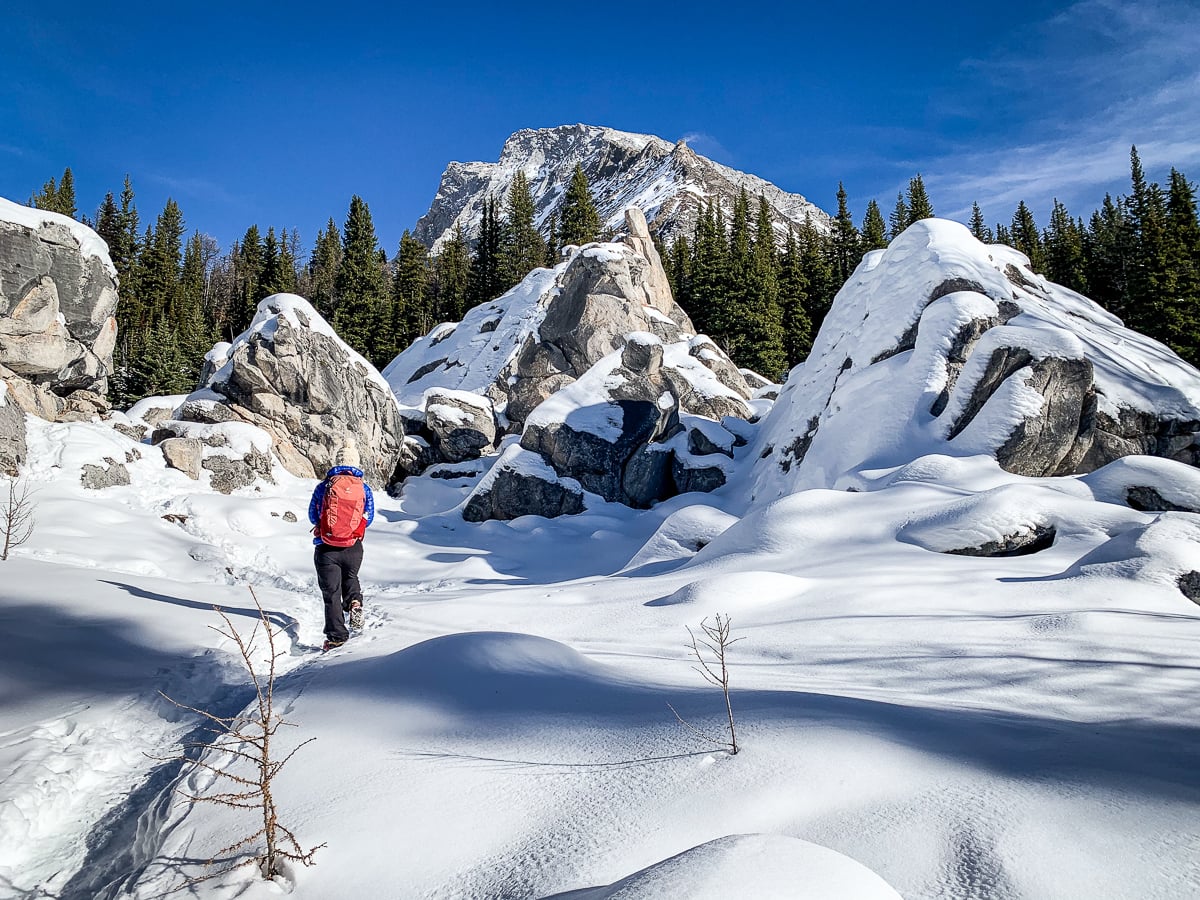
The Chester Lake snowshoe trail is a great example of a winter trail where we’ve enjoyed both options. Microspikes work well when the trail is hard-packed, but we prefer snowshoes when we want to explore the deep snow in the meadow.


Let me Help with Your Banff Itinerary?
We have a suite of Banff Travel Planning services that can take all the guesswork out of planning your trip! Book a 1 hour travel consultation or let me create a custom Banff Itinerary for you!
Ready to Put Your Winter Traction Devices to Use?
Once you have the right winter hiking traction devices, the fun part is deciding where to go. We have plenty of favourite winter trails around Banff, Lake Louise and Kananaskis where you can put your MICROspikes or snowshoes to good use.
For easier outings, start with our easy winter hikes in Banff or easy winter hikes in Kananaskis.
If you’re hoping for a true snowshoeing experience, check out our easy Kananaskis snowshoe trails, best Lake Louise snowshoe trails and complete guide to snowshoeing in Banff.
Trail conditions can change quickly in winter, so be sure to check current conditions before heading out and choose the traction device that makes the most sense for the day.
Support Human Created Content

Hi, we’re Dan & Celine Brewer, locals from just outside Banff National Park. Every article, itinerary, and recommendation we share is rooted in our real experiences and love for this place. If you’ve found our content helpful, please consider supporting us:
- Make a small donation: Your support directly fuels our work and keeps our stories genuine.
- Purchase a guide or itinerary: Essential tools that help plan your trip and support local creators at the same time.
- Book lodging or tours through our affiliate links: You pay the same price, but we earn a small commission that helps us keep producing content.
Thank you for valuing authentic, human-created content. Your support allows us to help even more Banff travellers!

Dan Brewer, a life-long Alberta resident, calls Canmore home along with his wife and two kids. He is the co-owner of Travel Banff Canada, where he gets to share his passion for the Canadian Rocky Mountains. Dan, along with his family, love being outdoors doing one of the many activities they enjoy in the mountains: hiking, mountain biking, paddleboarding, skiing, snowshoeing and cross-country skiing.
When he's not in Canmore enjoying one of his favourite local hikes, you can find him hopping on a plane to explore a new country with his family or working on one of their other two travel sites: Family Can Travel and Baby Can Travel.